
dsh-mcp-bridge
Install six curated MCP servers into DSH in one command — and find out which of them actually work on your machine.
When you need this
- You want your DSH agent to have MCP tools (browser automation, session memory, file access) without hand-writing six configs and getting the quoting wrong
- A server will not start and you cannot tell whether it is the config, the package or your network
- You want a list that says which servers are genuinely reachable, rather than another copy of the upstream docs
Every curated server is started, handshaken and its tool count checked in CI — everything answers with 13 tools, memory with 9, filesystem with 14.

One install gives your dsh agent a set of MCP servers that are started and queried on every push — not a raw YAML you have to figure out. Every curated server has a machine-readable definition in servers/, and scripts/verify-servers.mjs checks each one's connectivity, so "verified" is a CI-guaranteed claim, not marketing.
Tools appear to the model as mcp__<serverName>__<toolName> (same server-qualified shape as Claude Code / Codex). The bridge itself is DSH's built-in @deepseek-ai/dsh-mcp-client: stdio + streamable-http, auto-reconnect, HMR hot-swap.
中文文档见 README.zh.md。
Feedback
Installs are visible in the download counts; whether this helps is not. If you use it, one line about the actual task is worth more than a star — particularly if it did not work, which is the case that never gets reported:
- what you were trying to do
- whether it did it
- what was missing or wrong
Tell me in an issue — or if something is already broken, just open a normal bug report.
Requirements
This package is a configuration layer, not a plugin of its own. Its cordis.patch.yml
inserts entries that point at @deepseek-ai/dsh-mcp-client, which the host provides.
@deepseek-ai/dsh-mcp-clientmust be installed in the profile you are adding this to, at the version matching your DSH line.- It is declared as a permissive optional peer (
>=0.1.0-rc.6) rather than a dependency. Pinning it previously forced an old copy into the tree whose own peers (dsh-tools@^0.0.1-rc.1) conflict with current DSH releases, which made installation fail on version resolution. Reported as issue #2.
If installation fails, check that the client version in your profile matches your DSH version:
npm view @deepseek-ai/dsh-mcp-client versions --json | tail -20
Interactive installer
npx dsh-mcp-bridge init          # pick servers interactively
npx dsh-mcp-bridge list          # catalog + verification status
npx dsh-mcp-bridge validate      # list the MCP entries already in a profile
init writes real insert: entries into the profile's user patch layer
($DSH_HOME/profiles/<name>/cordis.patch.yml), so your selection survives plugin
upgrades and coexists with your own patches. It warns about servers that need
environment variables or a placeholder path to edit.
Why not just configure the MCP servers yourself?
Because the fiddly parts are not the YAML — they are everything around it.
- The user patch layer overrides existing entries; naming a new id there fails with
patch: entry "x" not found. New servers needinsert:. - Config nested one level too shallow parses to
config: null, and the server silently never starts. - A server that connects but exposes no tools looks exactly like a working one until you ask the model.
This bundle ships working shapes, an installer that writes them correctly (init), inspectors
(list, validate) and a verifier that actually connects.
Quick start
Prereqs: dsh and pnpm on PATH (dsh plugin forwards to pnpm; install with npm i -g pnpm).
dsh plugin --profile web add dsh-mcp-bridge
# local checkout:  dsh plugin --profile web add ./dsh-mcp-bridge
dsh web        # restart the profile
The demo server (MCP official everything) is enabled by default — no API key, pure local npx. After restart, ask your model to "call the everything server's echo tool with hello" and it should use mcp__everything__echo.
First run downloads the server packages via
npx; subsequent runs are cached.
Curated catalog
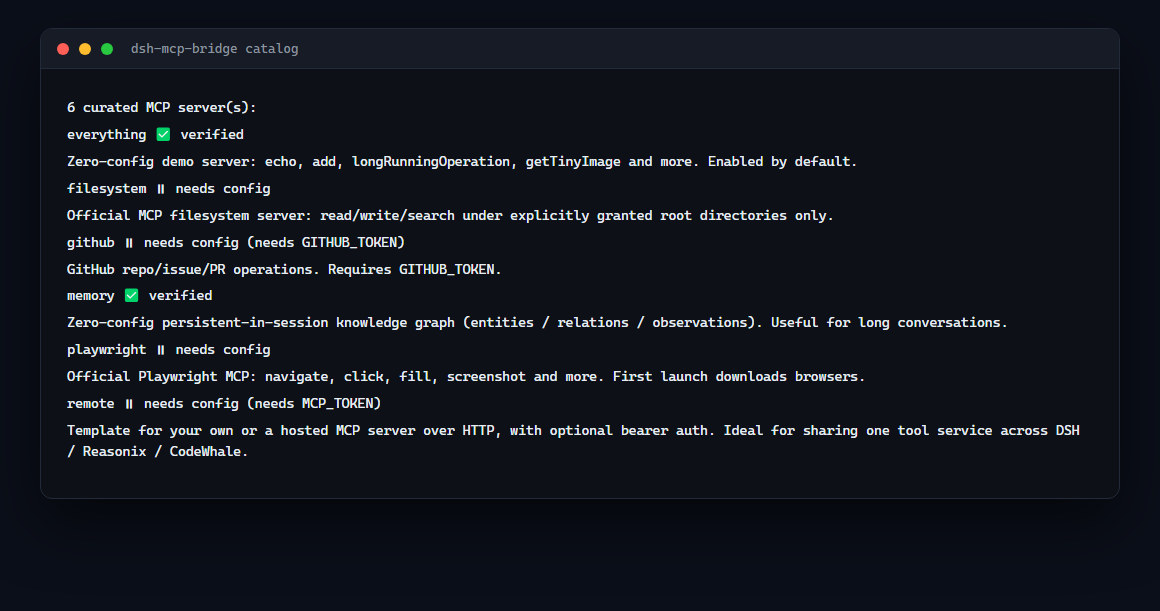
To enable a commented preset, uncomment its block in the profile's cordis.patch.yml (hot-reloaded via HMR) or edit cordis.patch.yml in this package.
Verify the catalog yourself
npm install          # brings @deepseek-ai/dsh-mcp-client → the MCP SDK
npm run verify       # or: node scripts/verify-servers.mjs
Prints PASS / SKIP / FAIL per server; exits non-zero on any failure. VERIFY_TIMEOUT_MS=15000 tunes the per-server timeout. Single-server troubleshooting: node scripts/probe-server.mjs npx -y your-mcp-server.
Adding your own MCP server
Each server is one @deepseek-ai/dsh-mcp-client entry. Either add it to the profile's user patch layer (recommended, HMR applies it without restart):
# $DSH_HOME/profiles/<name>/cordis.patch.yml
- id: mcp-myserver
  name: '@deepseek-ai/dsh-mcp-client'
  config:
    serverName: myserver          # namespace, unique per process ([A-Za-z0-9_-]{1,32})
    transport: stdio              # or streamable-http
    command: npx
    args: ['-y', 'your-mcp-server']
    env:
      YOUR_TOKEN: !!js process.env.YOUR_TOKEN
…or drop a definition into servers/ (so verify covers it) and add the matching entry to cordis.patch.yml here.
Config fields (from dsh-mcp-client)
Linking up with Reasonix / CodeWhale
All three are agent harnesses — MCP is the shared language. Any server you run for Reasonix or CodeWhale can be added here, and a local streamable-http server you own can serve DSH, Reasonix and CodeWhale from one process. See servers/remote-http.json.
Troubleshooting (Windows)
- Headless verification hangs (
dsh --profile <name> "task"): the profile needs@deepseek-ai/dsh-headlessindsh.profile.bundles(add it manually;dsh plugin add @deepseek-ai/dsh-headlessfails with 404 on its unpublished dependency). Without it the tree activates but no agent consumes the task. npxis fine on Windows: the MCP SDK usescross-spawn, which resolves.cmdshims — nonpx.exeneeded.- Server connects but no tools: check the profile logs;
failOnStartupError: falsemeans the entry activates without tools on failure.
Releasing (npm)
npm version patch(or bumppackage.jsonmanually), commit, tagvX.Y.Z.git push origin main --tags.- GitHub Actions (
publish.yml) publishes to npm — requires npm trusted publisher (OIDC) linked to the repo. Setup: npm → Access Tokens → Generate new token → Publish with GitHub Actions.
Give the repo the GitHub topic dsh-plugin so it shows up in the community lists (awesome-dsh-plugin, WhaleHub).
License
MIT — see LICENSE.
A server that is not in the list
The catalog is a starting point, not a ceiling. add installs any npm-published MCP server into a
profile and then probes it, so the result is "it works" or "here is what broke":
npx dsh-mcp-bridge add @modelcontextprotocol/server-memory
npx dsh-mcp-bridge add some-mcp-server --name some --env SOME_API_KEY
Wrote memory (@modelcontextprotocol/server-memory) to ~/.dsh/profiles/web/cordis.patch.yml

Checking that it actually starts...
  OK — 9 tool(s) listed
If the probe fails, the entry stays written so you can fix it in place, and the message says where:
  FAILED at connect: MCP error -32000: Connection closed
  the entry is still written so you can fix it in place:
    ~/.dsh/profiles/web/cordis.patch.yml
Options: --profile <name> (defaults to the first profile), --name <serverName> (defaults to a
name derived from the package), --args a,b (extra arguments), --env KEY1,KEY2 (environment
variables passed through from the environment), --timeout <seconds>.
Removing a server
npx dsh-mcp-bridge remove memory --profile web
Removes one - insert: entry from the profile's patch layer, leaving every other entry and the
header comment alone. --dry-run shows what would be removed without writing; an unknown name exits
2 and lists the entries that are present. Restart the profile for it to take effect.
When a server does not start
Installing is half the job. When a server never appears in your tool list, doctor starts each
one, completes the MCP handshake and lists its tools, so you can see where it broke:
npx dsh-mcp-bridge doctor
Diagnosing 7 curated server(s), 60s each…

  ✅ everything     16 tools
  ⏸  filesystem     needs configuration first — MCP error -32000: Connection closed
       → fill in its settings before diagnosing: npx -y @modelcontextprotocol/server-filesystem C:/path/to/allowed/root
  ⏸  github         needs GITHUB_TOKEN
  ✅ memory         9 tools
  ✅ playwright     25 tools
  ⏸  remote         needs MCP_TOKEN
  ✅ sequential-thinking 1 tools

4 ok, 3 skipped, 0 failed
Failed stages are reported separately because the advice differs:
Servers that are simply not configured yet are reported as skipped, not failed — a placeholder path is not a bug.
Other commands: list (catalog), init (install), validate (what is in a profile).
Related
Part of the dsh-toolkit family — small, independently useful pieces for DeepSeek Harness:
- dsh-mcp-bridge — install six curated MCP servers, verified in CI
- dsh-win-toolkit — clipboard, notifications, hosts, port checks on Windows
- dsh-netassist — network and proxy diagnosis with a concrete next step
- dsh-driftwatch — behaviour-drift reports between two session logs
- dsh-ledger — what the agent did to your files, provably unaltered
- dsh-release-evidence — one verifiable artifact per release
- mcp-netassist — the same network checks as an MCP server, any client