
NORA (Night Owl Research Agent)
A fully automatic, domain-aware AI research agent for Geoscientists, Remote Sensing researchers, and GIScientists — powered entirely by Claude Code skills.
Quick Start
NORA runs inside Claude Code. There is no Python entry point, no server to spin up, and no build step — you just drop the skills into Claude Code's skill directory and invoke the launcher.
Step 1 — Install Claude Code
Install Claude Code first. Any of the official distributions works:
- CLI (recommended):
npm install -g @anthropic-ai/claude-code claude --version - Desktop app (macOS / Windows): download from https://claude.com/claude-code
- VS Code extension: install "Claude Code" from the Marketplace
- Web: https://claude.ai/code
Sign in once with your Anthropic account so Claude Code can reach the API.
Step 2 — Get NORA onto your machine
git clone https://github.com/GRIND-Lab-Core/night_owl_research_agent.git
cd night_owl_research_agent
Step 3 — Install the skills into Claude Code
Claude Code looks for skills under ~/.claude/skills/ (user-level, available in every project) or <project>/.claude/skills/ (project-local). Copy the entire skills/ folder from this repo into one of those locations.
macOS / Linux (user-level — recommended):
mkdir -p ~/.claude/skills
cp -R skills/* ~/.claude/skills/
Windows PowerShell (user-level):
New-Item -ItemType Directory -Force -Path "$env:USERPROFILE\.claude\skills" | Out-Null
Copy-Item -Recurse -Force .\skills\* "$env:USERPROFILE\.claude\skills\"
Windows bash / Git Bash:
mkdir -p "$USERPROFILE/.claude/skills"
cp -R skills/* "$USERPROFILE/.claude/skills/"
Project-local alternative (skills only visible when Claude Code is opened in this folder):
mkdir -p .claude/skills
cp -R skills/* .claude/skills/
Also copy the launcher slash command so /launcher is available:
# macOS / Linux
mkdir -p ~/.claude/commands
cp .claude/commands/launcher.md ~/.claude/commands/
# Windows PowerShell
New-Item -ItemType Directory -Force -Path "$env:USERPROFILE\.claude\commands" | Out-Null
Copy-Item -Force .\.claude\commands\launcher.md "$env:USERPROFILE\.claude\commands\"
Verify the install — open Claude Code and run:
/skills
You should see the NORA skills (full-pipeline, lit-review, idea-discovery-pipeline, deploy-experiment, paper-draft, …) listed.
Step 4 — Start a research session
Open the night_owl_research_agent folder in Claude Code (this gives NORA access to CLAUDE.md, RESEARCH_PLAN.md, output/, memory/, and tools/), then pick one of the two entry points:
Option A — interactive launcher (best for first-time users):
/launcher
The launcher walks you through a short questionnaire — research topic, stage to start from, control flags (AUTO_PROCEED, HUMAN_CHECKPOINT, COMPACT_MODE, REVIEWER_DIFFICULTY) — and routes to the correct skill.
Option B — end-to-end pipeline (best when you already know what you want to run):
Skill: full-pipeline
"Your research direction here, e.g. 'urban soundscape inequality via street-view + audio foundation models'"
or, if you prefer a slash-style invocation:
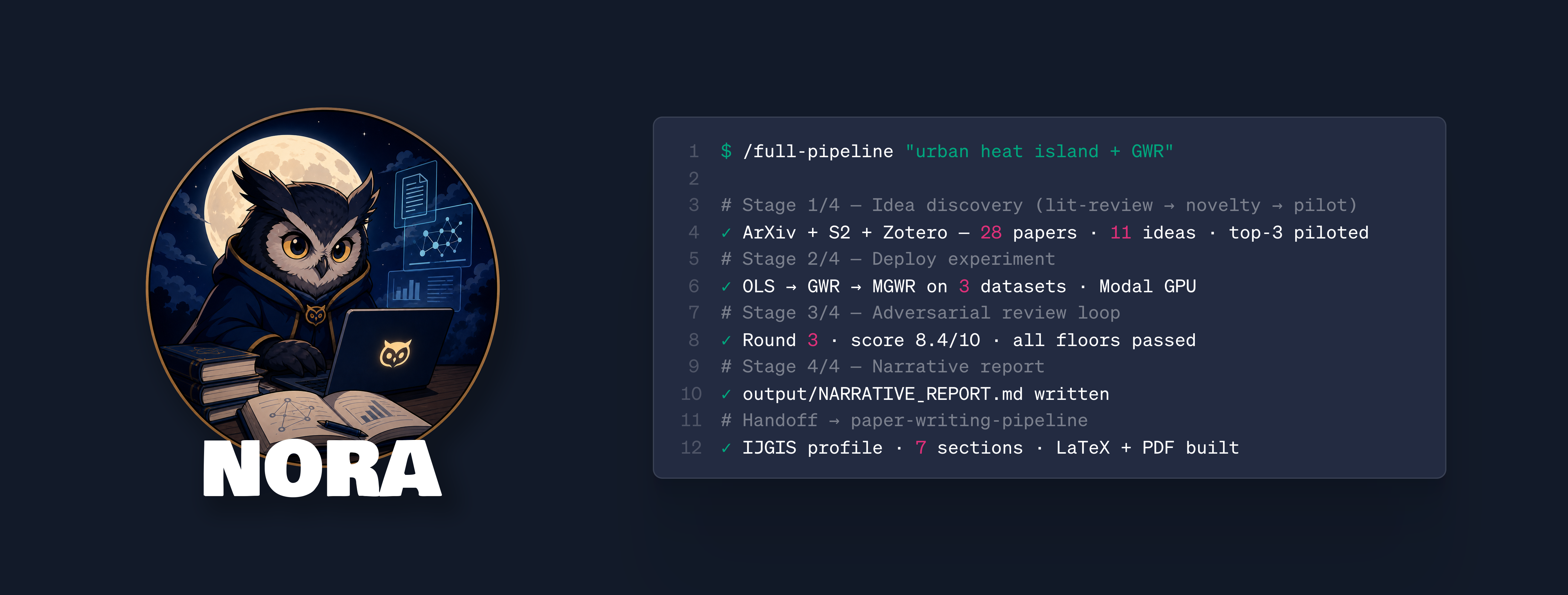
/full-pipeline "your research direction"
full-pipeline chains all four stages:
idea-discovery-pipeline → deploy-experiment → auto-review-loop → generate-report
and then hands off to paper-writing-pipeline for the manuscript.
Tip: for reproducibility, fill in RESEARCH_PLAN.md (or BRIEF.md) in the project root before launching. When either file is present, skills read it as the authoritative brief and ignore conflicting $ARGUMENTS.
Step 5 — (Optional) Enable extras
- MCP servers — edit
.mcp.jsonand register with Claude Code (/mcpinside the chat) to enablefilesystem,fetch,arxiv_mcp,geo_mcp,github, andbrave_search. Seemcp/README_MCP.md. - Hooks —
settings.jsonwiresharness/hooks/*.shinto Claude Code's lifecycle (writeshandoff.jsonon session end, validates tool use, sends desktop notifications). On Windows, run the hook scripts via Git Bash or WSL. - W&B — if your experiments use Weights & Biases, run
wandb loginonce on the host wheredeploy-experimentwill launch training. - API keys — set
ANTHROPIC_API_KEY(for Claude Code), plus any optional keys you want to use (SEMANTIC_SCHOLAR_API_KEY,GITHUB_TOKEN,BRAVE_API_KEY).
Prerequisites summary
What It Does
NORA automates the complete academic research lifecycle using Claude Code skills — Markdown-defined workflows that Claude reads and executes, selecting appropriate tools and methods based on context.
- Literature review — searches ArXiv, Semantic Scholar, local papers, Zotero, and Obsidian; synthesizes findings and identifies ranked research gaps.
- Idea discovery — generates 8–12 research ideas from literature gaps, validates novelty via multi-source search + external reviewer, and pilot-tests the top candidates. Pilots run a mandatory local-GPU presence check first (
nvidia-smi→ CUDA, then MPS, thennone); when a local GPU is detected, every pilot launches on it instead of silently falling back to CPU or remote. - Method refinement — iteratively refines vague research directions into problem-anchored, implementation-ready proposals via adversarial review (up to 5 rounds, score ≥ 9 target).
- Experiment design & execution — produces claim-driven experiment roadmaps and deploys to local, remote SSH, or Modal serverless GPU (Track A), or runs spatial/GIScience methods on CPU (Track B), or both for mixed GeoAI. The same mandatory local-GPU check runs at Step 0 of
deploy-experimentso any ML/DL workload (pilot or full) executes on the local GPU when present. - Data acquisition — discovers, evaluates, downloads, validates, and documents datasets from government portals, APIs, cloud archives, and open repositories with full provenance.
- Spatial analysis — guideline-driven: classifies the analytical objective, runs ESDA, and applies geospatial diagnostics conditionally on the research question. MAUP discussion, GWR/MGWR, residual Moran's I, alternative spatial weights, and spatial CV are triggered only when the claim depends on them; when in doubt the skill pauses for a human checkpoint instead of running heavyweight checks (or skipping reviewer-expected ones) by reflex.
- Adversarial review — up to 4 rounds of generator–evaluator-separated review with per-criterion hard floors;
medium/hard/nightmarereviewer modes via Codex MCP,codex exec, or a Claude subagent. Domain personas (giscience,remote-sensing,spatial-data-science) apply geo-specific must-checks only where the paper's claims actually depend on them instead of penalizing every paper for missing MAUP / GWR discussion. - Report + paper writing — consolidates every pipeline artifact into
output/NARRATIVE_REPORT.md, then runspaper-writing-pipelineto produce a journal-ready manuscript (Markdown → LaTeX → PDF/DOCX) with journal-specific profiles for IJGIS, IEEE TGRS, ISPRS JPRS, RSE, AAG, TGIS, and more.
Architecture
NORA is a skills-first system. All research logic lives in Markdown skill files that Claude reads and executes.
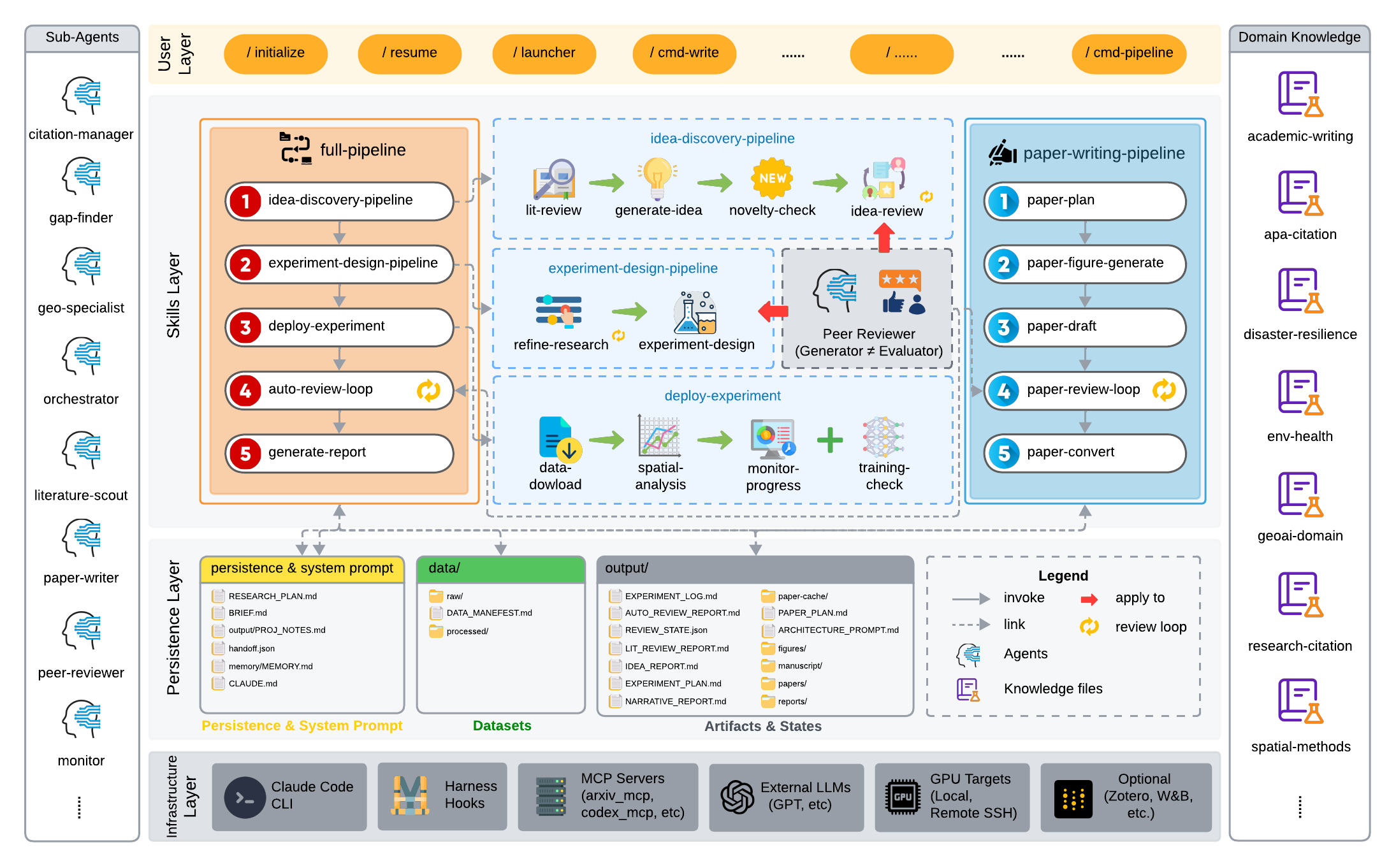
Skills describe workflow logic in Markdown. Claude reads a skill to understand the workflow, then decides the exact sequence of actions based on context — the skill provides guidelines and decision frameworks, not rigid procedures.
You (or /launcher)
    ↓ invokes
Skill SKILL.md  ←─── reads domain knowledge from skills/knowledge/
    ↓ Claude decides what to do
CLI tools (tools/arxiv_fetch.py, etc.) + inline Python + MCP servers as needed
    ↓ produce
Output files (reports, paper-cache, figures, manuscript)
    ↓ read by
Next skill in pipeline
The single installed slash command is /launcher. Every other skill is invoked by name (Claude Code's native Skill tool) or by being called internally from another skill.
Skills
23 workflow skills in skills/ plus domain knowledge in skills/knowledge/. Each skill is a self-contained Markdown workflow file.
Workflow Skills
Domain Knowledge
Control Flags
Edit CLAUDE.md before starting a long run:
AUTO_PROCEED: false       # true = auto-select top idea after discovery; false = wait for approval
HUMAN_CHECKPOINT: true    # true = pause after each review round; false = run autonomously
COMPACT_MODE: false       # true = use output/PROJ_NOTES.md instead of full logs (saves context)
EXTERNAL_REVIEW: false    # true = use Claude subagent / external reviewer LLM
full-pipeline also accepts REVIEWER_DIFFICULTY = medium | hard | nightmare and ARXIV_DOWNLOAD = true | false. Overrides can be passed inline, e.g.:
/full-pipeline "topic — AUTO_PROCEED: false, difficulty: nightmare"
Harness Engineering
Claude Code's hook system automates lifecycle management (configured in settings.json):
Autoresearch Scoring Loop
paper-draft writes draft
    ↓
paper-review-loop scores it (separate context — generator–evaluator separation)
    ↓
All 5 dimension floors met AND weighted avg ≥ 7.5? → ACCEPT
    ↓ (else)
paper-draft revises (max 3 attempts total)
    ↓
If still not accepted → flag for human review
Accept requires weighted avg ≥ 7.5 and all five floors met.
Journal Templates & Profiles
Templates enforce correct structure, section ordering, word limits, and formatting. paper-covert additionally loads a YAML profile that drives LaTeX conversion.
Markdown templates (templates/)
Submission profiles (skills/paper-covert/profiles/)
aag_annals.yaml, generic.yaml, ieee_tgrs.yaml, ijgis.yaml, isprs_jprs.yaml, rse.yaml, tgis.yaml.
MCP Servers
Declared in .mcp.json. Setup notes in mcp/README_MCP.md.
Key Output Files
Project Structure
night_owl_research_agent/
├── CLAUDE.md                        ← Dashboard and project conventions
├── README.md                        ← This file
├── design_principle.md              ← Skill-level design principles (export → Excel via tools/)
├── design_principle_agents.md       ← Sub-agent design principles
├── settings.json                    ← Claude Code hooks, permissions, env vars
├── .mcp.json                        ← MCP server declarations
│
├── .claude/
│   ├── commands/
│   │   └── launcher.md              ← /launcher (only installed slash command)
│   └── agents/                      ← Specialist sub-agent definitions (9 total)
│       ├── orchestrator.md
│       ├── literature-scout.md
│       ├── synthesis-analyst.md
│       ├── gap-finder.md
│       ├── hypothesis-generator.md
│       ├── geo-specialist.md
│       ├── paper-writer.md
│       ├── peer-reviewer.md
│       └── citation-manager.md
│
├── skills/                          ← 22 workflow skills + knowledge/
│   ├── full-pipeline/SKILL.md
│   ├── lit-review/SKILL.md
│   ├── idea-discovery-pipeline/SKILL.md
│   ├── generate-idea/SKILL.md
│   ├── novelty-check/SKILL.md
│   ├── idea-review/SKILL.md
│   ├── refine-research/SKILL.md
│   ├── experiment-design/SKILL.md
│   ├── experiment-design-pipeline/SKILL.md
│   ├── deploy-experiment/SKILL.md
│   ├── data-download/SKILL.md
│   ├── spatial-analysis/SKILL.md
│   ├── auto-review-loop/SKILL.md
│   ├── generate-report/{SKILL.md, templates/}
│   ├── paper-writing-pipeline/SKILL.md
│   ├── paper-plan/SKILL.md
│   ├── paper-figure-generate/{SKILL.md, templates/}
│   ├── paper-draft/{SKILL.md, templates/}
│   ├── paper-review-loop/{SKILL.md, templates/}
│   ├── paper-covert/{SKILL.md, profiles/, templates/}
│   ├── submit-check/SKILL.md
│   ├── training-check/SKILL.md
│   └── knowledge/                   ← Domain reference files
│
├── tools/                           ← CLI utilities (called by skills + harness)
│   ├── arxiv_fetch.py
│   ├── semantic_scholar_fetch.py
│   ├── convert_skills_to_llm_chat.py
│   ├── export_design_principle_table.py        ← exports design_principle.md tables to Excel
│   ├── export_agent_design_principle_table.py  ← exports design_principle_agents.md tables
│   ├── telemetry_stage_marker.py               ← called by skill_marker hook (per-skill timing)
│   └── telemetry_aggregate.py                  ← called by Stop hook (session/stage telemetry)
│
├── configs/
│   └── default.yaml                 ← Scoring weights, domain keywords
│
├── templates/                       ← Project + paper templates
│   ├── EXPERIMENT_LOG_TEMPLATE.md
│   ├── EXPERIMENT_PLAN_TEMPLATE.md
│   ├── FINDINGS_TEMPLATE.md
│   ├── HANDOFF_TEMPLATE.json
│   ├── IDEA_CANDIDATES_TEMPLATE.md
│   ├── PAPER_PLAN_TEMPLATE.md
│   ├── RESEARCH_CONTRACT_TEMPLATE.md
│   ├── RESEARCH_PLAN_TEMPLATE.md
│   ├── REVIEW_STATE_TEMPLATE.json
│   ├── geoscience/ (nature_geoscience, grl_template)
│   ├── remote_sensing/ (ieee_tgrs, isprs_jprs, remote_sensing_env)
│   └── giscience/ (ijgis, transactions_gis, annals_aag)
│
├── harness/
│   ├── hooks/ (pre_tool_use, post_tool_use, skill_marker, stop_hook, notification)
│   └── prompts/system_geo.md
│
├── mcp/                             ← MCP server implementations
│   ├── geo_mcp_server.py
│   └── README_MCP.md
│
├── memory/MEMORY.md                 ← Persistent session memory
│
├── output/                          ← All generated outputs
│   ├── AUTO_REVIEW.md
│   ├── REVIEW_STATE.json
│   ├── ARCHITECTURE_DIAGRAM_PROMPTS.md
│   ├── papers/
│   ├── figures/
│   └── reports/
│
├── res/nora_architecture.png        ← Architecture diagram
│
└── archived/                        ← Retired skills and pre-skill Python modules
Contributing
- Fork this repository.
- Add skills in
skills/<name>/SKILL.md. - Add journal templates in
templates/(plus a YAML profile inskills/paper-covert/profiles/if needed). - Add domain knowledge in
skills/knowledge/.
License
MIT License. See LICENSE for details.
Design Principles
Two living documents describe the rules NORA's skills and sub-agents follow. Treat them as the source of truth when you write or change a skill.
Both files can be exported to Excel for review or workshop use:
python tools/export_design_principle_table.py
python tools/export_agent_design_principle_table.py
Inspired By
NORA's design borrows ideas from several open-source projects. Credit and gratitude to their authors:
- BZBarrett/superpowers — skill-pack patterns for extending Claude Code with composable Markdown workflows.
- BZBarrett/get-shit-done — pragmatic harness patterns for getting long-running agentic work to actually finish.
- wanshuiyin/Auto-claude-code-research-in-sleep — "research while you sleep" autonomous-loop concept that motivated NORA's overnight pipelines, handoff.json recovery, and adversarial review loop.
- karpathy/autoresearch — generator–evaluator separation and the per-criterion floors + weighted-average scoring loop adapted into
auto-review-loopandpaper-review-loop.
If your project influenced NORA and is missing here, please open an issue and we will add it.
Citation
If you use NORA in your research, please cite the arXiv preprint:
Zhou, B., Wu, Q., Huang, X., Ning, H., Li, D., & Zhang, Z. (2026). NORA: Night Owl Research Agent — Autonomous AI Research for Geoscience, Remote Sensing, and GIScience. arXiv:2605.02092. https://arxiv.org/abs/2605.02092
@misc{zhou2026nora,
  title         = {NORA: Night Owl Research Agent --- Autonomous AI Research for Geoscience, Remote Sensing, and GIScience},
  author        = {Zhou, Bing and Wu, Qiusheng and Huang, Xiao and Ning, Huan and Li, Diya and Zhang, Ziyi},
  year          = {2026},
  eprint        = {2605.02092},
  archivePrefix = {arXiv},
  url           = {https://arxiv.org/abs/2605.02092},
  howpublished  = {\url{https://github.com/GRIND-Lab-Core/night_owl_research_agent}}
}