
tmux-bridge-mcp
English | 简体中文
A standalone MCP server that lets AI agents (Claude Code, Gemini CLI, Codex, Kimi CLI) communicate with each other through tmux panes. It talks directly to tmux -- no external dependencies beyond tmux itself.
🖥️ What is tmux?
tmux is a terminal multiplexer -- it lets you split one terminal window into multiple panes, each running its own process independently. Think of it as "tabs on steroids" for your terminal.
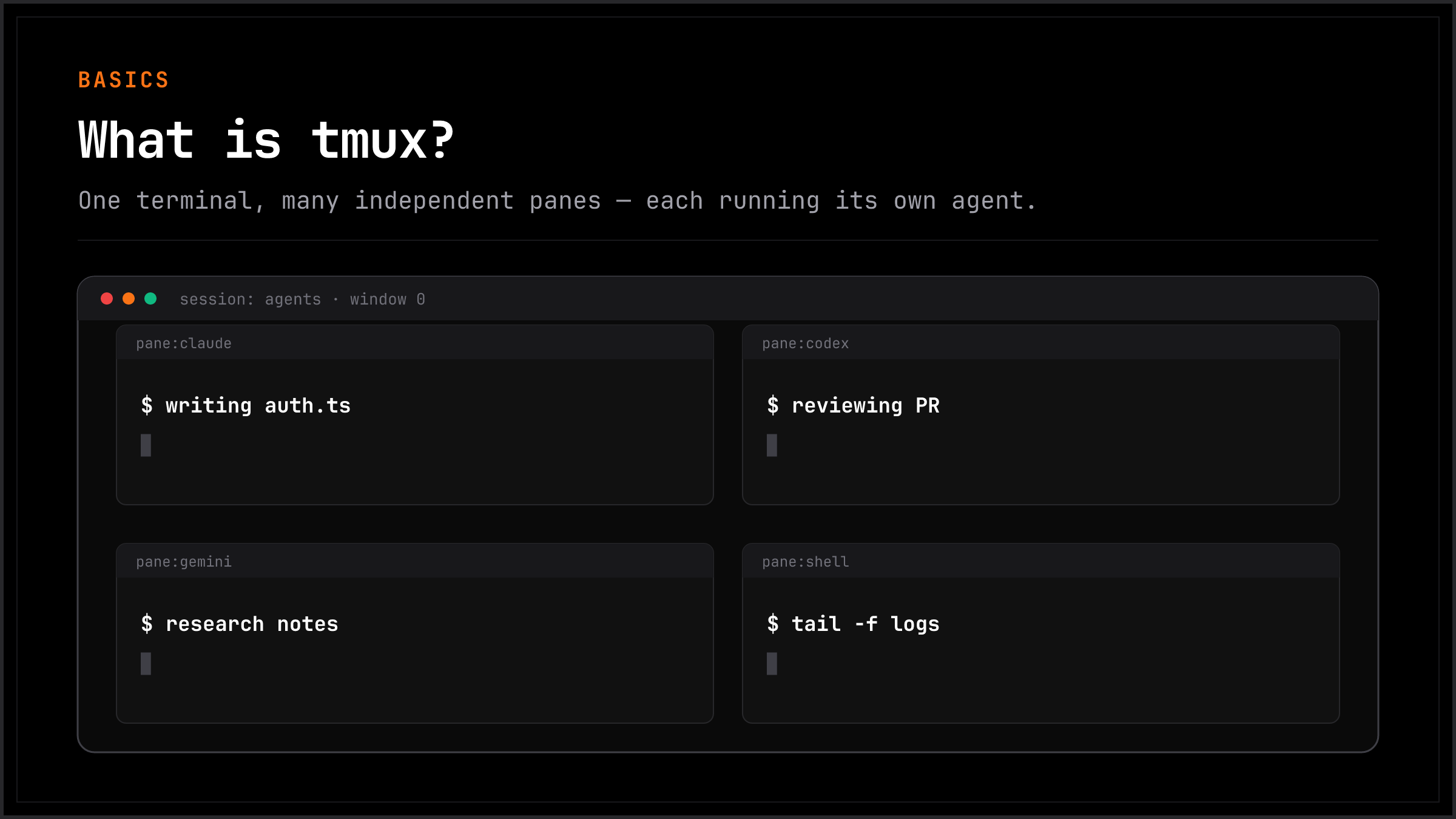
+-------------------------------+
|  Pane 1       |  Pane 2       |
|  Claude Code  |  Codex        |
|  writing code |  reviewing    |
|               |               |
+---------------+---------------+
|  Pane 3       |  Pane 4       |
|  Gemini CLI   |  tail -f logs |
|  researching  |  monitoring   |
+-------------------------------+
Each pane is a full terminal. You can have Claude Code running in one, Codex in another, Gemini in a third -- all visible at the same time, all on the same machine.
The problem: these panes can't talk to each other. An agent in Pane 1 has no idea what's happening in Pane 2.
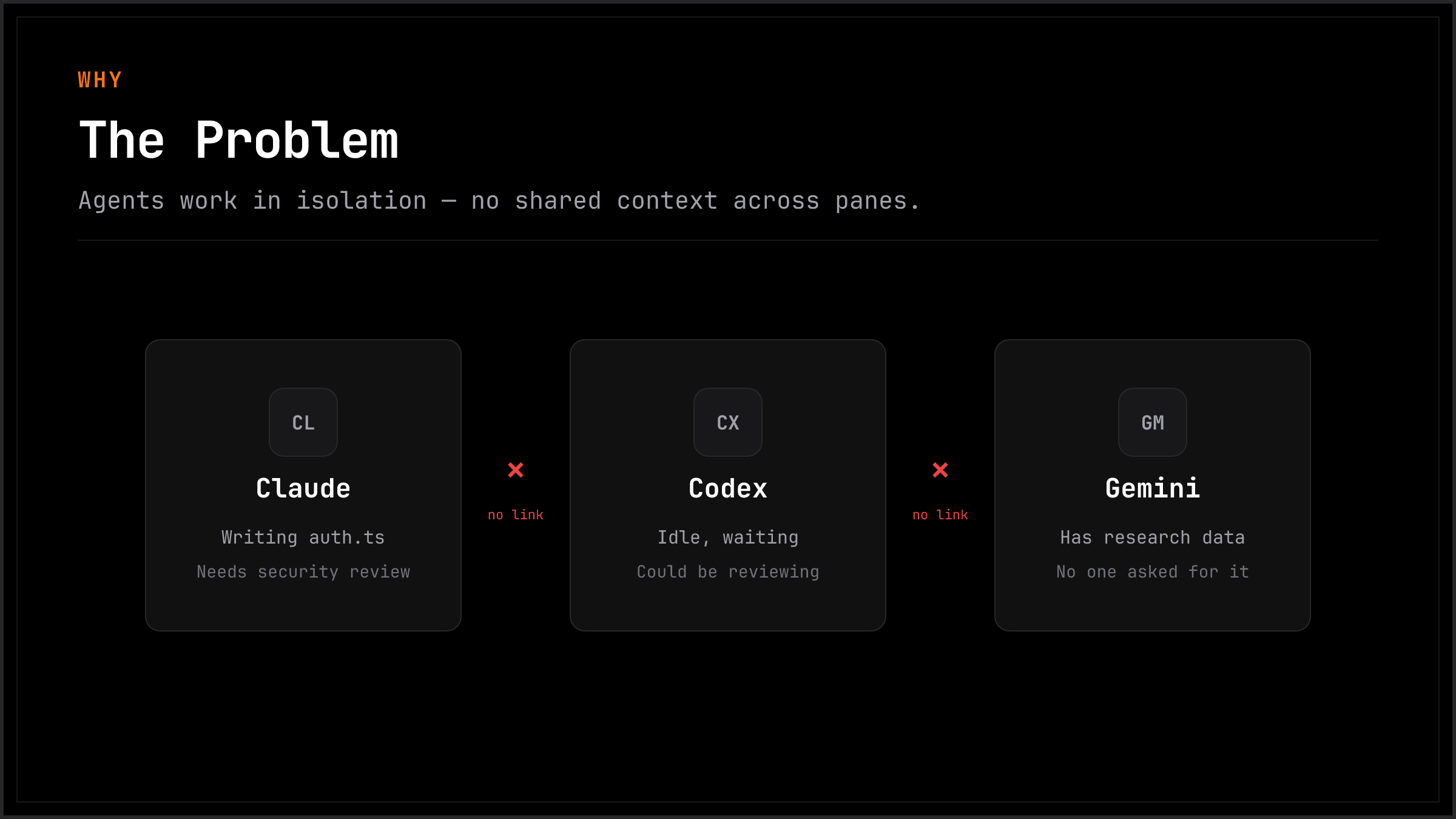
tmux-bridge fixes this. It gives every agent the ability to read, type, and send messages into any other pane.
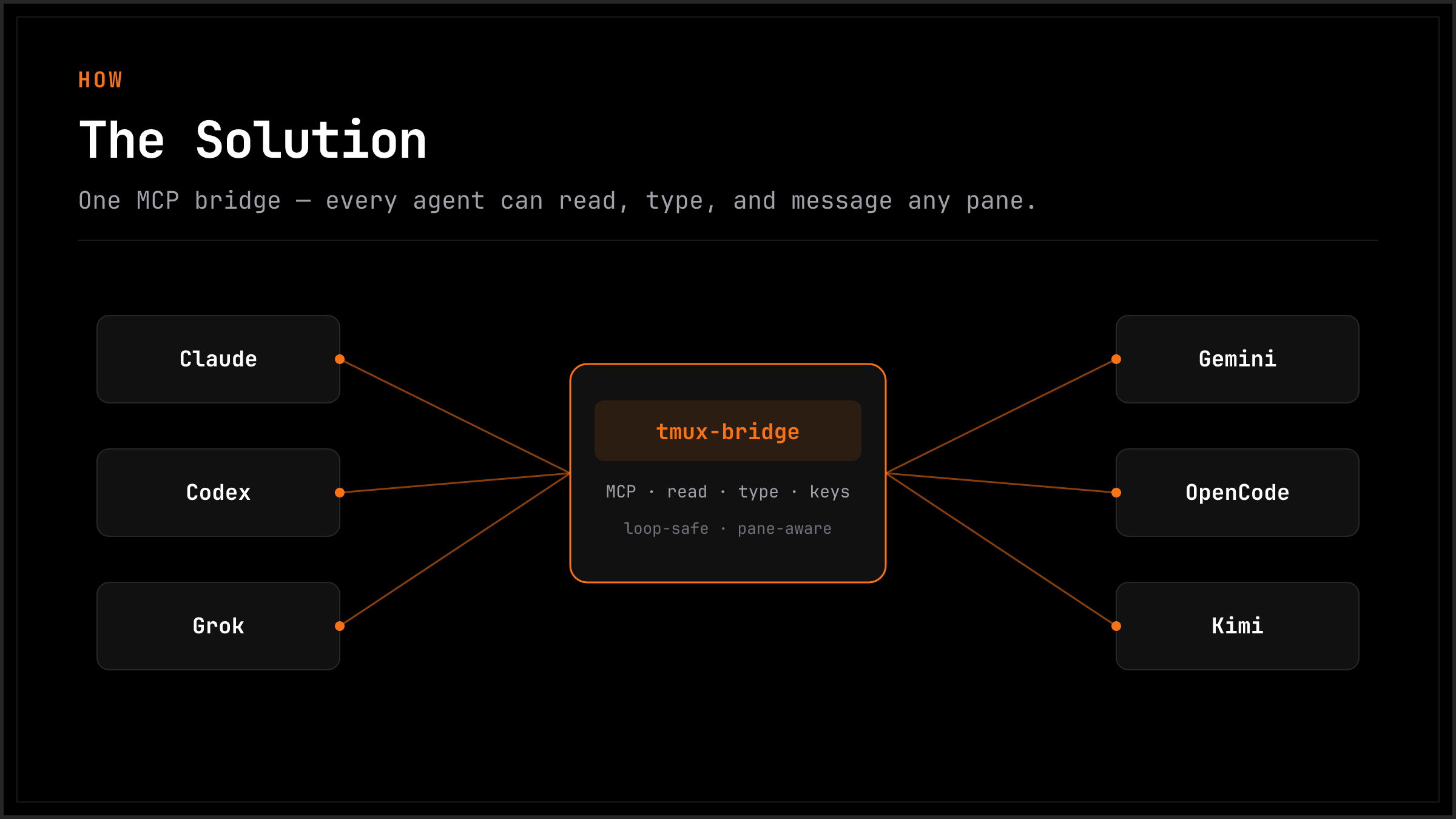
⚡ What can you do with tmux-bridge?
Once installed, your AI agents can:
All of this happens through standard MCP tool calls -- your agent doesn't need to learn any new syntax. If it supports MCP, it already knows how.
🤖 Supported Agents
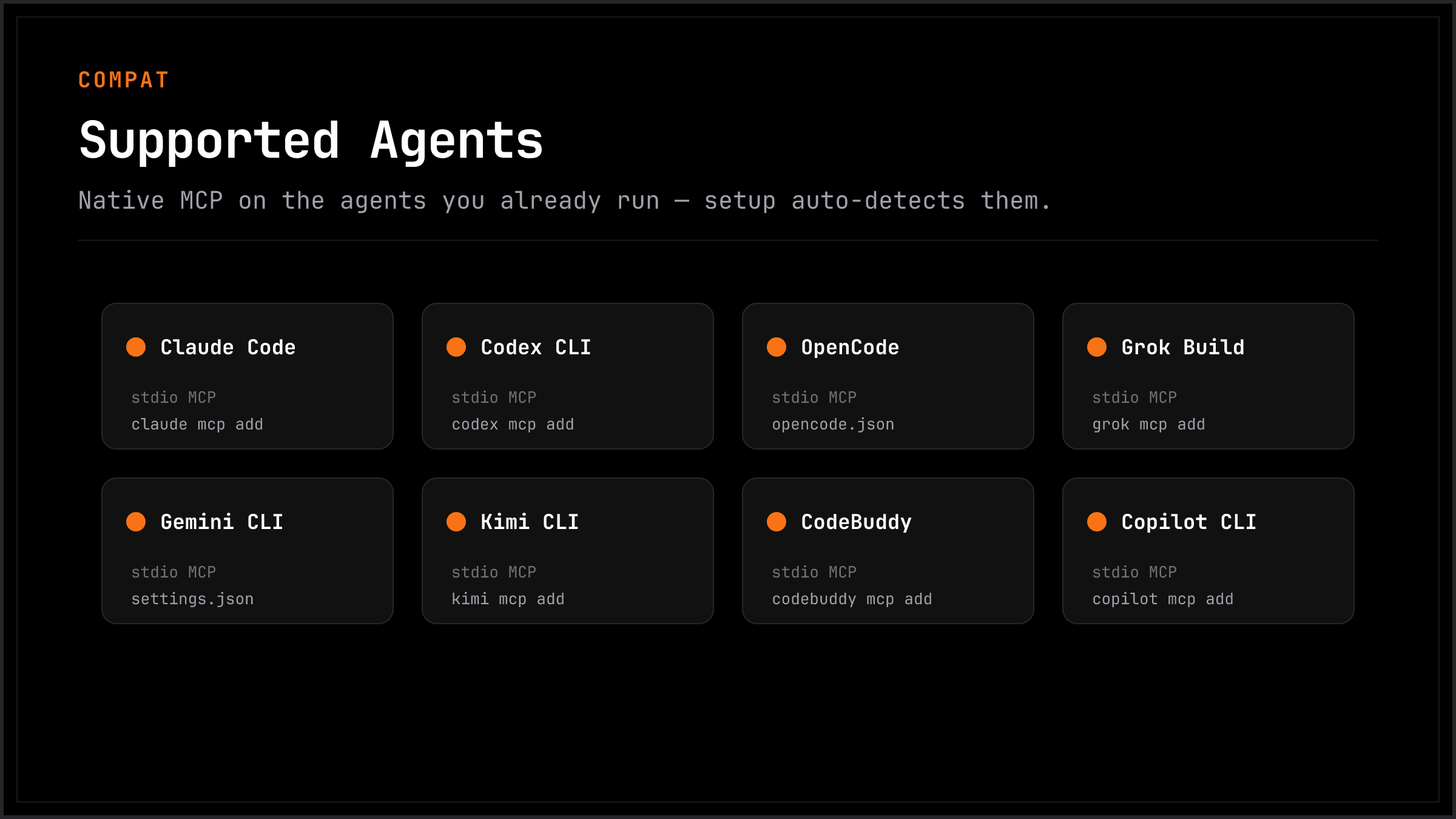
Tested and documented
Should work (any MCP-compatible agent)
tmux-bridge works with any agent that supports MCP over stdio. If your agent isn't listed, try adding the MCP config -- it will likely just work.
💡 Why
When you run multiple AI agents in separate terminals, they work in isolation. You end up copy-pasting context between them, manually relaying questions and answers, or losing track of what each agent is doing.
tmux-bridge solves this by giving every agent the ability to read, type, and send messages into any other terminal pane -- programmatically, through standard MCP tool calls.
Use cases:
- Code review pipeline -- Claude Code writes code in one pane, Codex reviews it in another, results flow back automatically
- Multi-model reasoning -- ask Gemini for research, feed the findings to Claude, let Codex verify the implementation
- Parallel workflows -- multiple Claude Code instances each handling a different part of a large task, coordinating through pane messages
- Monitoring -- an agent reads log output from a
tail -fpane and reacts to errors in real time
What you need:
If you already use tmux to run multiple agents side by side, tmux-bridge just makes them aware of each other.
😩 Without tmux-bridge
You're running Claude Code in one pane, Codex in another. Claude finishes writing a function and you want Codex to review it. Here's what actually happens:
- You read Claude's output. Scroll up. Copy the relevant part.
- Switch to Codex's pane. Paste it in. Type "review this code."
- Codex gives feedback. You copy that.
- Switch back to Claude. Paste Codex's feedback. "Fix these issues."
- Repeat for every round of review.
You are the message bus. Every interaction flows through your clipboard. You're not writing code anymore -- you're routing context between agents. With 3+ agents running, this becomes unmanageable within minutes.
🤔 Why not LangChain / CrewAI / A2A?
The key insight: you don't need a multi-agent framework. You need your existing agents to see each other. tmux-bridge adds exactly that -- a thin MCP layer over tmux -- and nothing more.
🚀 Quick Start
Prerequisites: tmux 3.2+ and Node.js 18+ must be installed.
One command to configure all your agents:
npx tmux-bridge-mcp setup
This auto-detects Claude Code, Codex, OpenCode, CodeBuddy, Copilot CLI, Grok Build, Gemini CLI, and Kimi CLI on your machine, then writes the correct MCP config for each one. Done in seconds.
Verify it works:
npx tmux-bridge-mcp --help
You should see the version and available commands. Restart your AI agent to activate the new tools.
See it in action:
npx tmux-bridge-mcp demo
Opens a 3-pane tmux session and runs a live cross-pane communication demo.
1. Install tmux
brew install tmux    # macOS
apt install tmux     # Linux
2. Add to your agent's MCP config
{
  "mcpServers": {
    "tmux-bridge": {
      "command": "npx",
      "args": ["-y", "tmux-bridge-mcp"]
    }
  }
}
Restart your agent. It now has 9 MCP tools for cross-pane communication.
🔄 Updating
# If installed globally
npm update -g tmux-bridge-mcp

# If using npx (auto-updates, but to force latest)
npx tmux-bridge-mcp@latest

# Check your current version
npx tmux-bridge-mcp --version
After updating, restart your agents to pick up the new version. If you use npx in your MCP config, it caches the package — run npx --yes tmux-bridge-mcp@latest once to pull the latest, then your agents will use it on next startup.
🏗️ How It Works
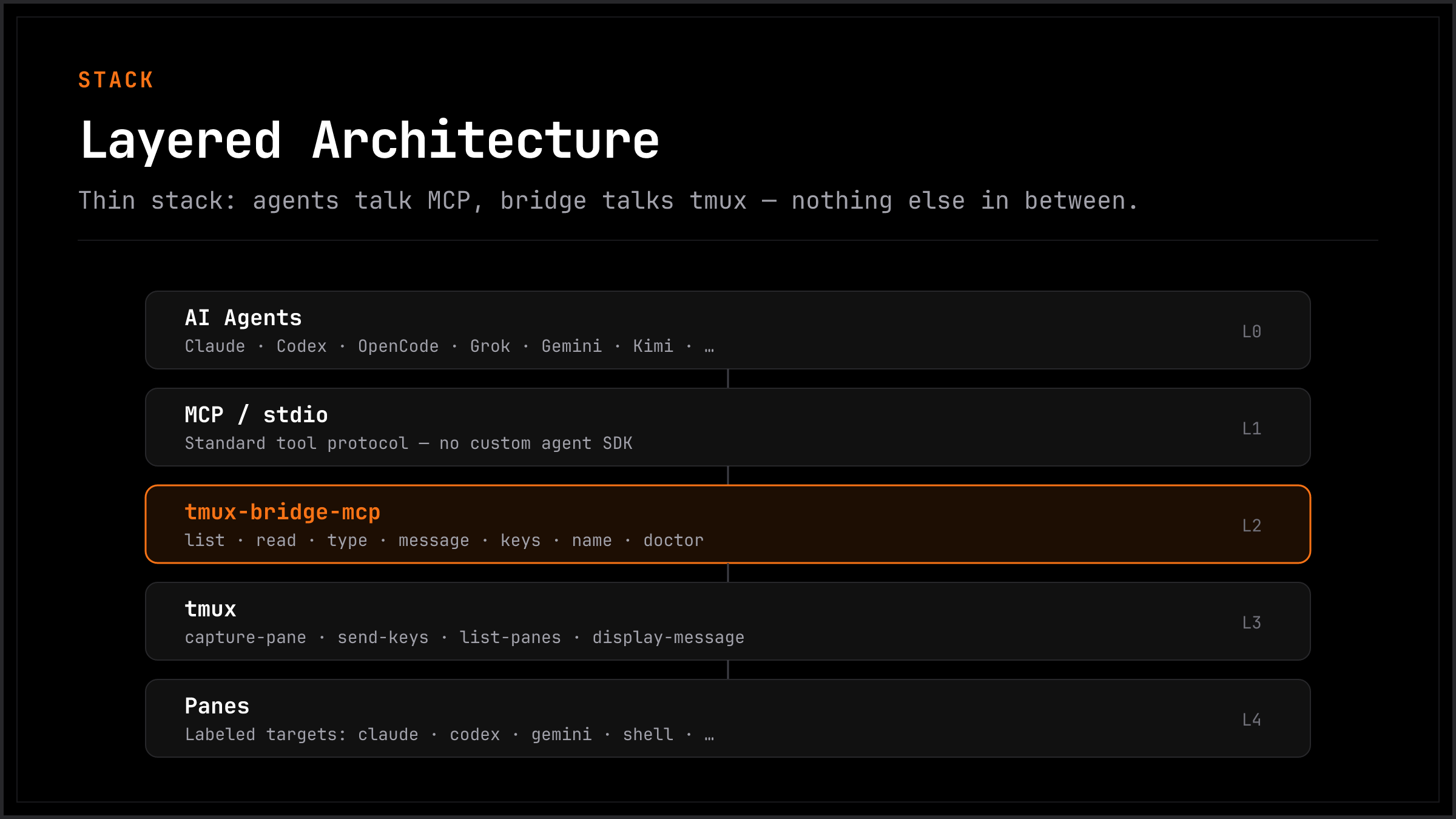
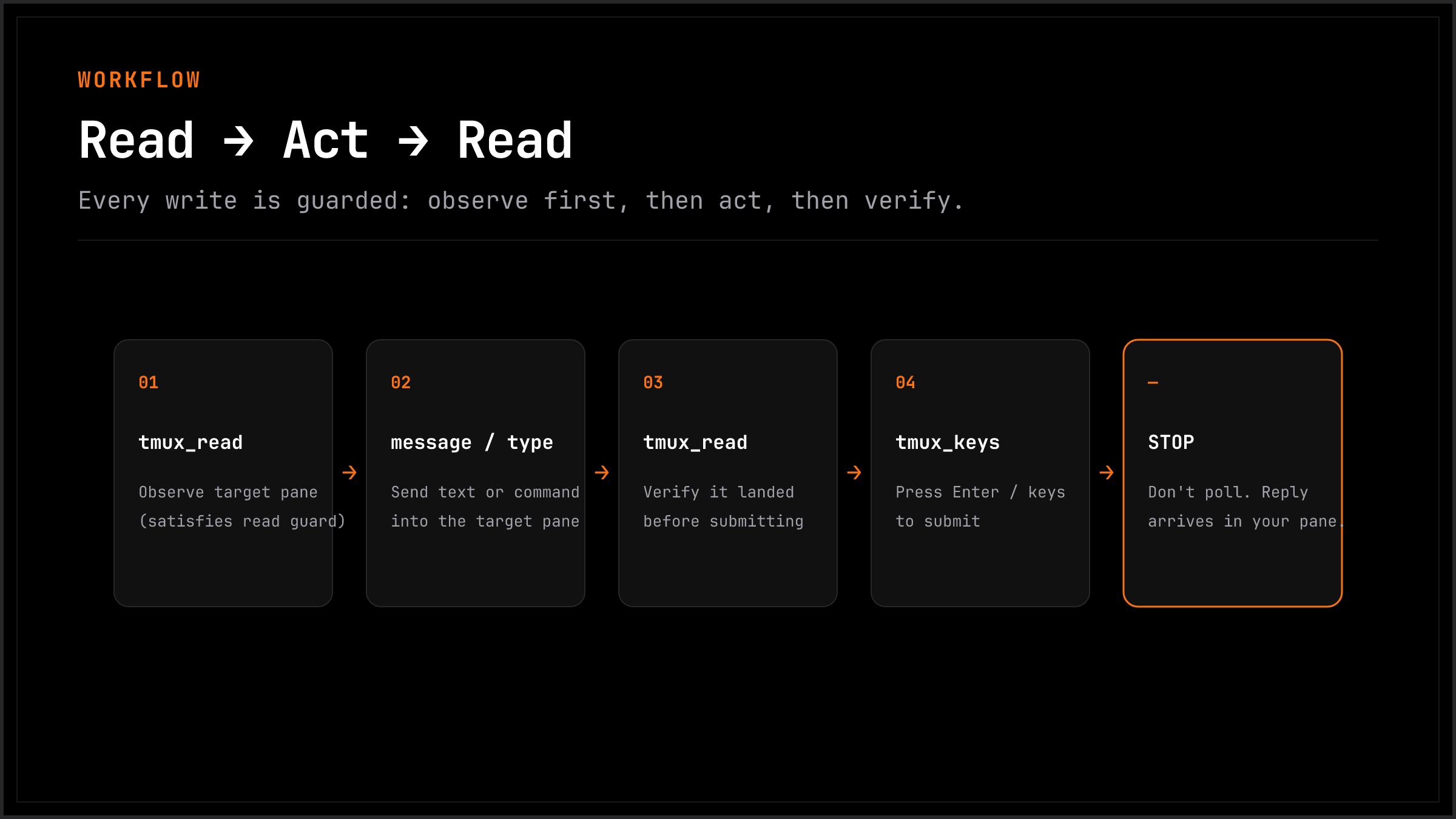
tmux-bridge runs as an MCP server over stdio. It calls tmux directly (capture-pane, send-keys, list-panes, etc.) -- no intermediate CLI layer.
MCP path (Gemini, Claude Code, Codex, any MCP client):
+--------------+  MCP/stdio  +---------------+  tmux API  +--------------+
|  MCP Agent   |<----------->|  tmux-bridge  |<---------->|  tmux panes  |
+--------------+             |  MCP server   |            +--------------+
                             +---------------+

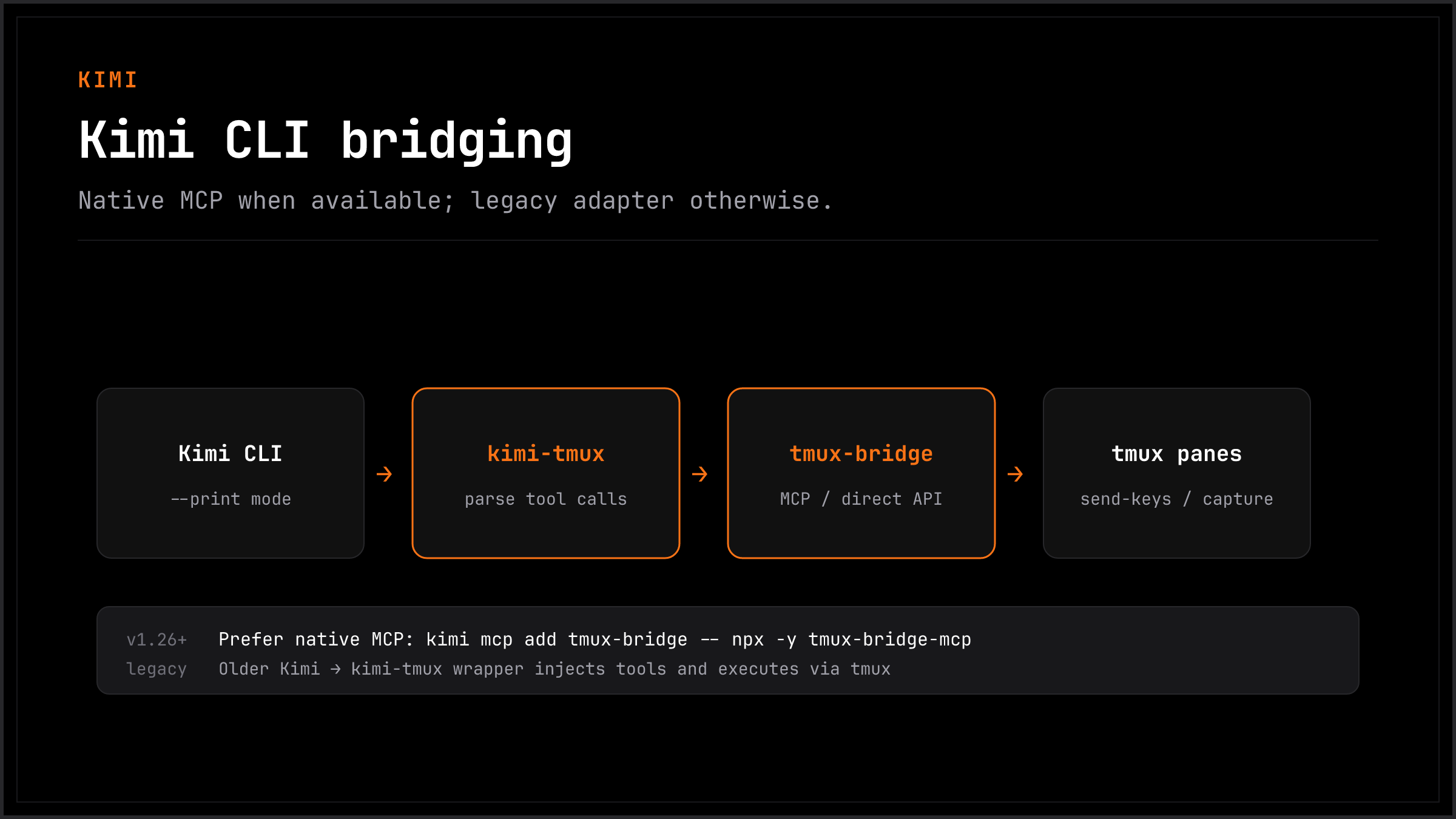
CLI path (Kimi):
+--------------+  --print    +---------------+  tmux API  +--------------+
|  Kimi CLI    |<----------->|  kimi-tmux    |<---------->|  tmux panes  |
+--------------+  tool parse |  adapter      |            +--------------+
                             +---------------+
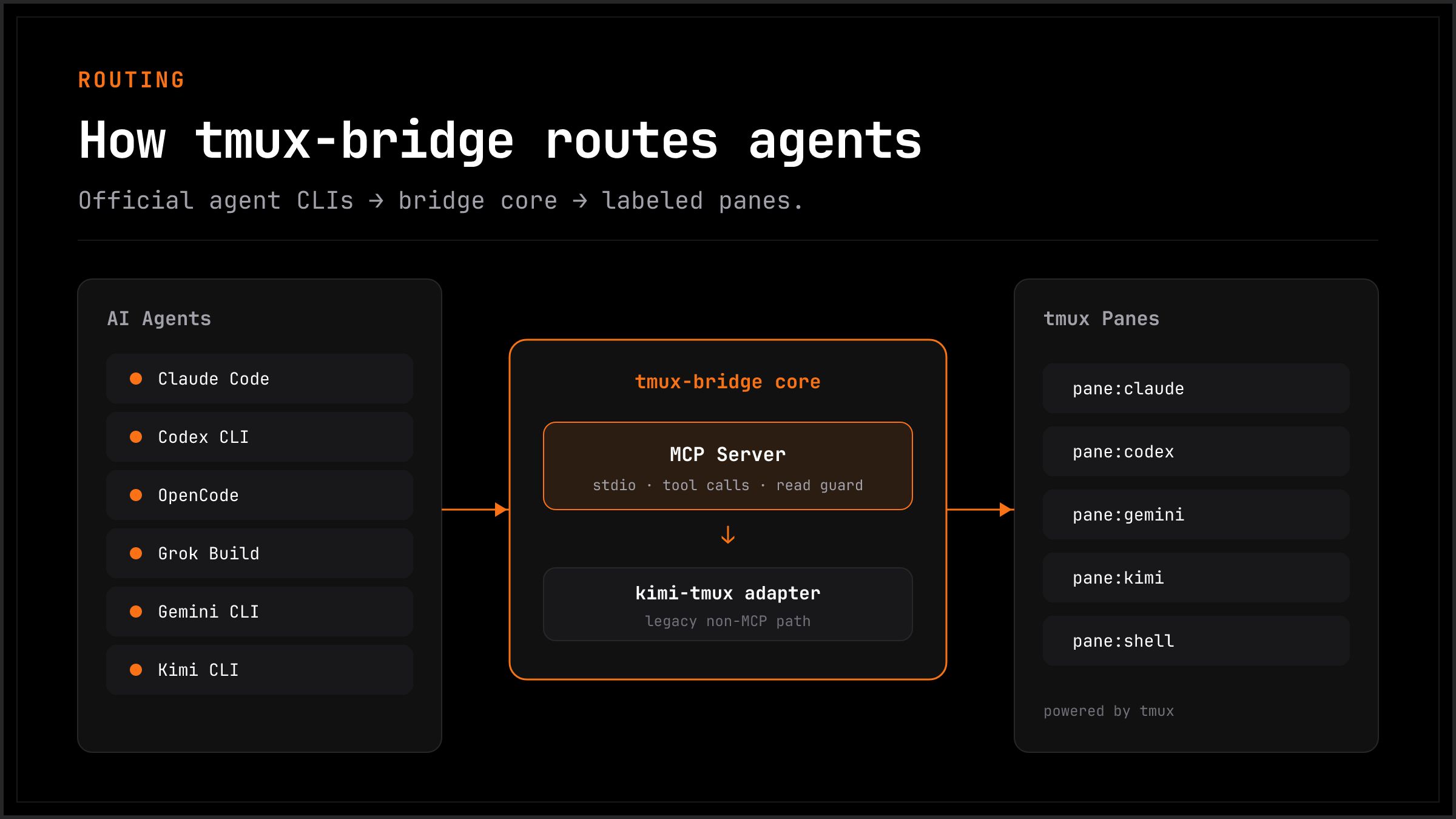
All cross-pane interactions follow the read-act-read workflow:
The read guard is enforced at the MCP layer: tmux_type, tmux_message, and tmux_keys will fail unless you call tmux_read on the target pane first.
⚙️ Setup Per Agent
Gemini CLI (native MCP)
Add to ~/.gemini/settings.json:
{
  "mcpServers": {
    "tmux-bridge": {
      "command": "npx",
      "args": ["tmux-bridge-mcp"]
    }
  }
}
Claude Code (native MCP)
Add to your project's .mcp.json or global MCP config:
{
  "mcpServers": {
    "tmux-bridge": {
      "command": "npx",
      "args": ["tmux-bridge-mcp"]
    }
  }
}
Codex (native MCP)
Add to your MCP config following the Codex MCP setup docs:
{
  "mcpServers": {
    "tmux-bridge": {
      "command": "npx",
      "args": ["tmux-bridge-mcp"]
    }
  }
}
OpenCode
opencode mcp add is interactive. tmux-bridge-mcp setup writes directly to
~/.config/opencode/opencode.json (or .jsonc):
{
  "mcp": {
    "tmux-bridge": {
      "type": "local",
      "command": ["npx", "-y", "tmux-bridge-mcp"],
      "enabled": true
    }
  }
}
CodeBuddy (Tencent)
codebuddy mcp add -s user tmux-bridge -- npx -y tmux-bridge-mcp
Fallback config path: ~/.codebuddy/.mcp.json (standard mcpServers JSON).
GitHub Copilot CLI
copilot mcp add tmux-bridge -- npx -y tmux-bridge-mcp
Fallback config path: ~/.copilot/mcp-config.json:
{
  "mcpServers": {
    "tmux-bridge": {
      "type": "local",
      "command": "npx",
      "args": ["-y", "tmux-bridge-mcp"],
      "tools": ["*"]
    }
  }
}
Grok Build
grok mcp add -s user tmux-bridge -- npx -y tmux-bridge-mcp
Fallback TOML in ~/.grok/config.toml:
[mcp_servers.tmux-bridge]
command = "npx"
args = [
    "-y",
    "tmux-bridge-mcp",
]
enabled = true
Kimi CLI
# Check your Kimi version
kimi --version
# v1.26+ → use native MCP (recommended)
# older  → use kimi-tmux wrapper
Native MCP (recommended, v1.26+):
kimi mcp add tmux-bridge -- npx tmux-bridge-mcp
Once added, Kimi uses all tmux-bridge tools directly -- no adapter needed.
Legacy wrapper (older versions):
For Kimi CLI versions without native MCP, kimi-tmux bridges the gap by injecting the system instruction as a prompt, running Kimi in --print mode, parsing tool-call blocks from output, and executing them via tmux.
kimi-tmux "list all tmux panes"
kimi-tmux "ask the agent in codex pane to review src/auth.ts"
kimi-tmux "read what claude is working on"
kimi-tmux --rounds 3 "send a message to gemini and wait for the result"
🔧 Tools Reference
Targets can be a pane ID (%0), session:window.pane (main:0.1), or a label (claude).
📖 Examples
Ask Claude to review a file (from Gemini)
tmux_list()
tmux_read(target="claude", lines=20)
tmux_message(target="claude", text="Please review src/auth.ts for security issues")
tmux_read(target="claude", lines=5)
tmux_keys(target="claude", keys=["Enter"])
Multi-agent coordination (from Kimi)
kimi-tmux "tell the claude pane to run the test suite"
kimi-tmux "ask gemini to summarize the test results in claude's pane"
Multi-agent layout
+-----------------------------------------------------------+
| tmux session                                              |
|                                                           |
| +------------+ +------------+ +----------+ +-----------+  |
| | Claude Code | |   Codex    | | Gemini   | |   Kimi    | |
| |  (MCP)     | |  (MCP)     | |  (MCP)   | |(kimi-tmux)| |
| |            | |            | |          | |           |  |
| | label:     | | label:     | | label:   | | label:    |  |
| | claude     | | codex      | | gemini   | | kimi      |  |
| +-----+------+ +-----+------+ +----+-----+ +-----+-----+ |
|       +---------------+-----------+--------------+        |
|           tmux-bridge (direct tmux IPC, no deps)          |
+-----------------------------------------------------------+
🌐 Environment Variables
🔒 Security Model
tmux-bridge is designed for local development on a single machine. It assumes all connected MCP agents are trusted:
- Any agent can read from or write to any pane in the tmux server — there is no per-pane access control.
- The read guard (must
tmux_readbeforetmux_type/tmux_keys) is a sequencing aid to prevent blind typing. It is not a security boundary. - Pane labels set via
tmux_nameare not authenticated — any agent can label or relabel any pane. - There is no encryption or authentication between agents. Communication happens through tmux's own IPC (Unix socket).
Do not use tmux-bridge in multi-tenant environments or expose the tmux socket over a network. It is built for the common case: one developer running multiple AI agents side by side on their own machine.
📝 System Instruction
For agents that support custom system prompts, use system-instruction/smux-skill.md. It teaches the read-act-read workflow and documents all available MCP tools.
🔗 Related Projects
smux vs tmux-bridge-mcp
👉 When to use smux: You want a complete tmux setup (keybindings, mouse support, status bar) and your agents support the skills system or you're comfortable injecting system prompts.
👉 When to use tmux-bridge-mcp: You want a drop-in MCP server that works with any MCP-compatible agent out of the box, without touching your tmux configuration.
tmux-bridge (/tmb) vs Claude Code Native (subagent + /codex + /gemini)
Verdict
tmux-bridge's real advantage comes down to one thing: persistent context. If you need an agent that remembers the last 30 turns of conversation and keeps following up on the same task, a tmux pane can do that -- a subagent cannot.
But for most tasks, native is better:
- Communication is more reliable (no tmux buffer truncation)
- Results are structured -- no need to parse terminal output
- Simpler to operate, one less layer of abstraction
Practical guidance:
- Short-lived, one-off tasks → native subagent /
/codex//gemini - Long-running sessions that need accumulated context (e.g., a reviewer continuously following the same PR) → tmux-bridge adds real value
- A multi-pane multi-role layout only pays off if each role genuinely needs cross-conversation state -- otherwise the overhead outweighs the benefit
📄 License
MIT