
culi (cà phê culi — the single dense peaberry bean) is the memory and context layer between your coding agents and your projects. It stores rules, lessons, styles, patterns, skills, and agent definitions as small Markdown cards, then routes a token-budgeted selection to Claude Code or Codex.
It is local-first, git-backed, and inspectable. Hooks and retrieval make no model calls; optional background learning proposes new knowledge for review. No Node, Python, or resident daemon is required.
What you get
- One cross-agent memory for Claude Code and Codex, with explicit
claude:<id>andcodex:<id>provenance. - Small, relevant context through hooks, with deeper on-demand retrieval through MCP.
- Background learning through Codex CLI, OpenAI API, Claude CLI, Anthropic API, or Ollama.
- Codex history recovery from its read-only local rollout database, automatically throttled and deduplicated when hooks do not provide a transcript path.
- A production-style local console for review, knowledge maintenance, delivery activity, Knowledge Pulse analytics, backend configuration, and light/dark themes.
- Plain files as truth under
~/.culi/knowledge/; SQLite holds rebuildable card-search tables plus preserved local activity state.
Why culi?
Quick start
go install github.com/hung12ct/culi/cmd/culi@latest
culi init                       # auto-detect Claude Code and Codex
culi serve                      # http://localhost:7378
Open a new coding-agent session after initialization. Codex users should run /hooks once and
trust the four generated Culi hooks. Verify the wiring with:
culi doctor --harness=codex
Ollama is optional. Without it, retrieval uses SQLite FTS/BM25. For semantic retrieval, install
Ollama and run ollama pull nomic-embed-text.
For harness-specific setup, adding your first cards, and importing existing instructions, see the getting started guide.
Console
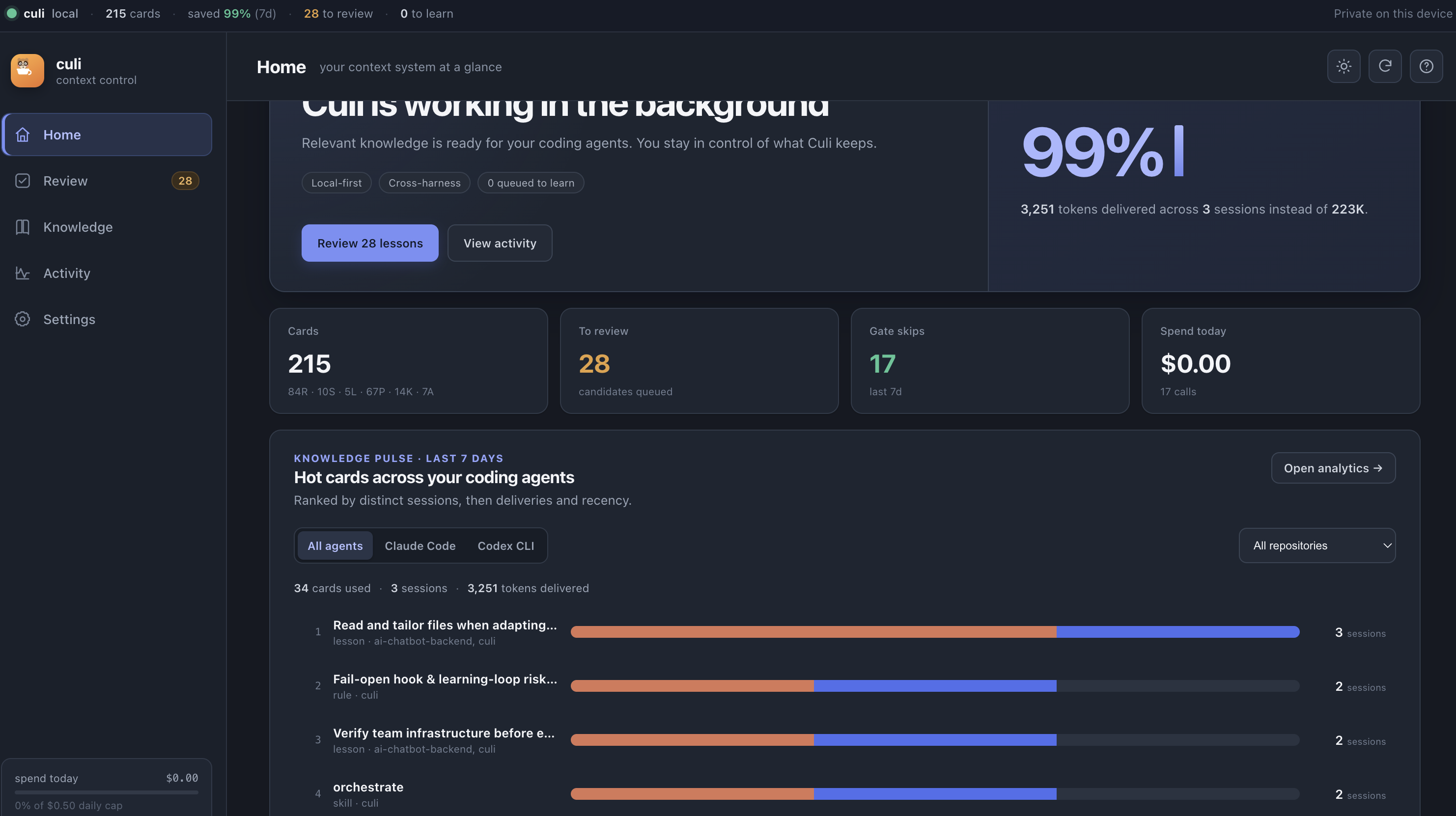
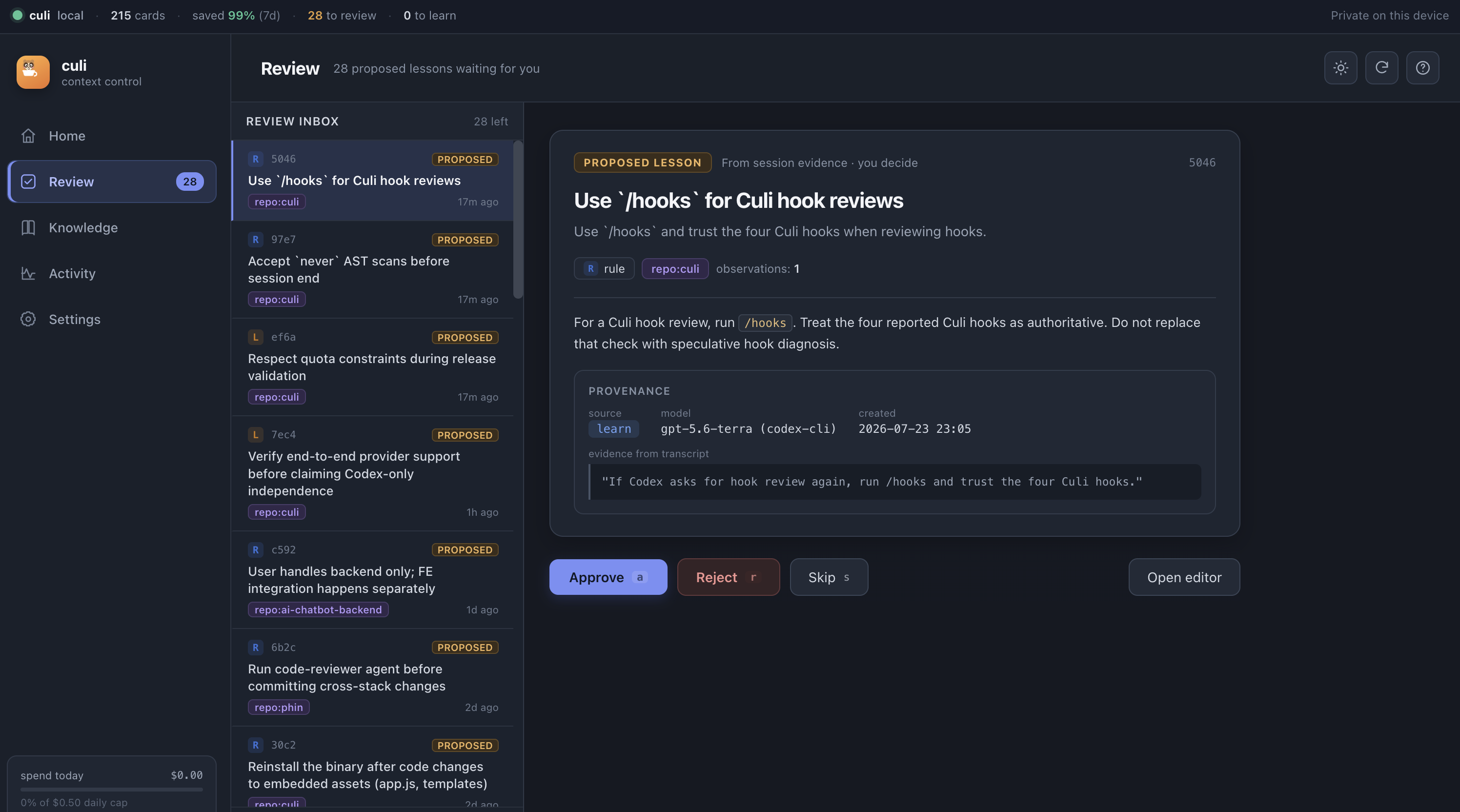
The local console makes Culi's behavior visible and reversible: review proposed lessons, search and edit cards, filter delivery activity by agent/repository/date, compare hot cards across Claude and Codex, and safely tune the learning backend.
| Home — health, next actions, and savings | Review — evidence-first lesson decisions |
|---|---|
 |  |
See the console guide and full screenshot gallery.
How it works
prompt ──► cheap gate ──► scope + keyword + optional semantic retrieval
                                      │
                              rank + budgeted pack
                                      │
                         Claude Code or Codex
                                      │
session transcript ──► background mining ──► review ──► knowledge cards
- Push: lifecycle hooks inject the best-fitting context. Any failure produces no injection and never blocks the coding agent.
- Pull: the local MCP server exposes
search_context,expand_card, andsave_lesson. - Learn: detached workers mine transcripts, synthesize style, and extract durable lessons under daily call/spend caps.
- Govern: imports and generated knowledge are staged or git-backed; retiring a card is reversible and hand-authored files are not silently rewritten.
Learning backends
The default auto provider tries configured APIs first, then signed-in Claude and Codex terminals.
Ollama is opt-in so Culi never silently chooses an unprepared local generation model. Model calls
never occur in prompt hooks.
See learning and cost for Codex backfill, authentication, caps, model defaults, and manual learning commands.
Documentation
- Getting started — install, initialize, verify, and add knowledge.
- Console — Home, Review, Knowledge Pulse, Activity, Settings, and themes.
- Knowledge and imports — card format, scopes, import/merge/apply, export, and git generation.
- Learning and cost — providers, auth, Codex recovery, caps, and troubleshooting.
- Configuration — complete
config.yamlreference and safe console settings. - Product vision — principles and future direction.
Common commands
Run culi help for the complete command list.
Safety contracts
- Hook failures fail open: empty output, exit 0, never block the agent.
- Prompt-path retrieval has no LLM calls and enforces its token cap twice.
- API spend and all-provider call counts have daily hard limits.
- Culi's own terminal-model calls are marked internal to prevent self-learning loops.
- Knowledge files are canonical; runtime SQLite state is migrated or rebuildable as appropriate.
- Destructive knowledge changes remain explicit and reversible.
Requirements
- Go 1.25+ for
go install(the Go toolchain can download the pinned version automatically). - Claude Code with lifecycle hooks and MCP, and/or Codex CLI 0.145+.
- Ollama with
nomic-embed-textis optional.
Status
Actively developed and dogfooded daily. Built on gopheragent. Issues and ideas are welcome.
License
MIT © 2026 hung12ct