@isoldex/sentinel
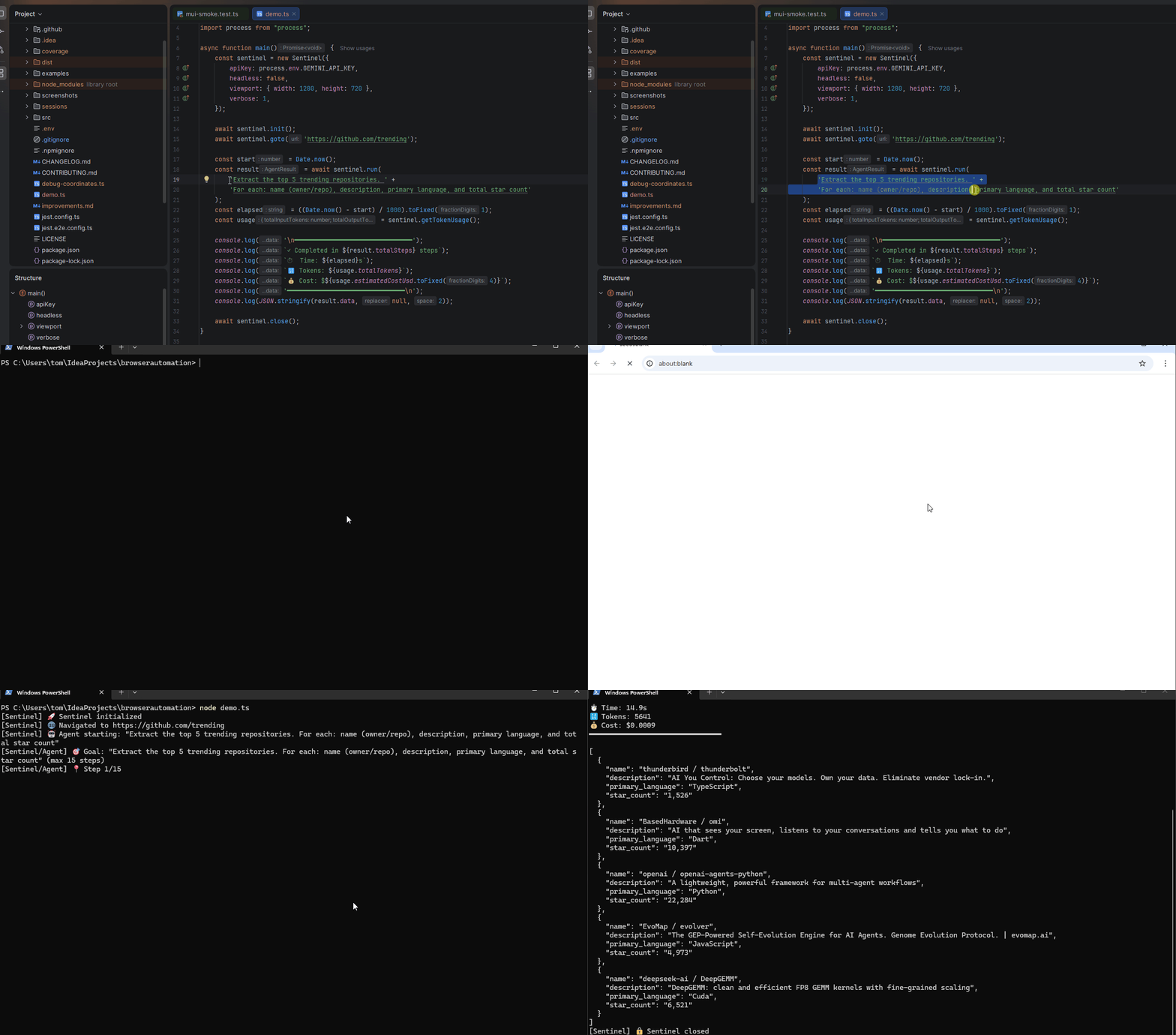
AI-powered browser automation for TypeScript. Describe what you want in plain English, Sentinel figures out the selectors, clicks, and extracts data.
Why Sentinel?
- 10× fewer LLM tokens than Stagehand (2–5k per action vs 29–51k)
- Self-healing selectors — cached after first run, auto-regenerate on break
- Multi-LLM support — OpenAI, Claude, Gemini, Ollama
- Built on Playwright — drop-in for existing Node.js projects
Install
npm install @isoldex/sentinel playwright
npx playwright install chromium
Gemini works out of the box. The other providers load their SDK on demand — install the one you use:
npm install @anthropic-ai/sdk   # ClaudeProvider
npm install openai              # OpenAIProvider
# OllamaProvider needs no package, just a running Ollama instance
Using the Playwright test fixture (@isoldex/sentinel/test) additionally requires @playwright/test.
Quick Start
import { Sentinel } from '@isoldex/sentinel';

const sentinel = new Sentinel({ apiKey: process.env.GEMINI_API_KEY! });
await sentinel.init();
await sentinel.goto('https://github.com/trending');

const result = await sentinel.run(
  'Extract the top 5 trending repositories with name, description, and star count'
);

console.log(result.data);
await sentinel.close();
Real-world example: Amazon.de
A more complex multi-step task — search, filter by brand, sort by rating, extract structured data:
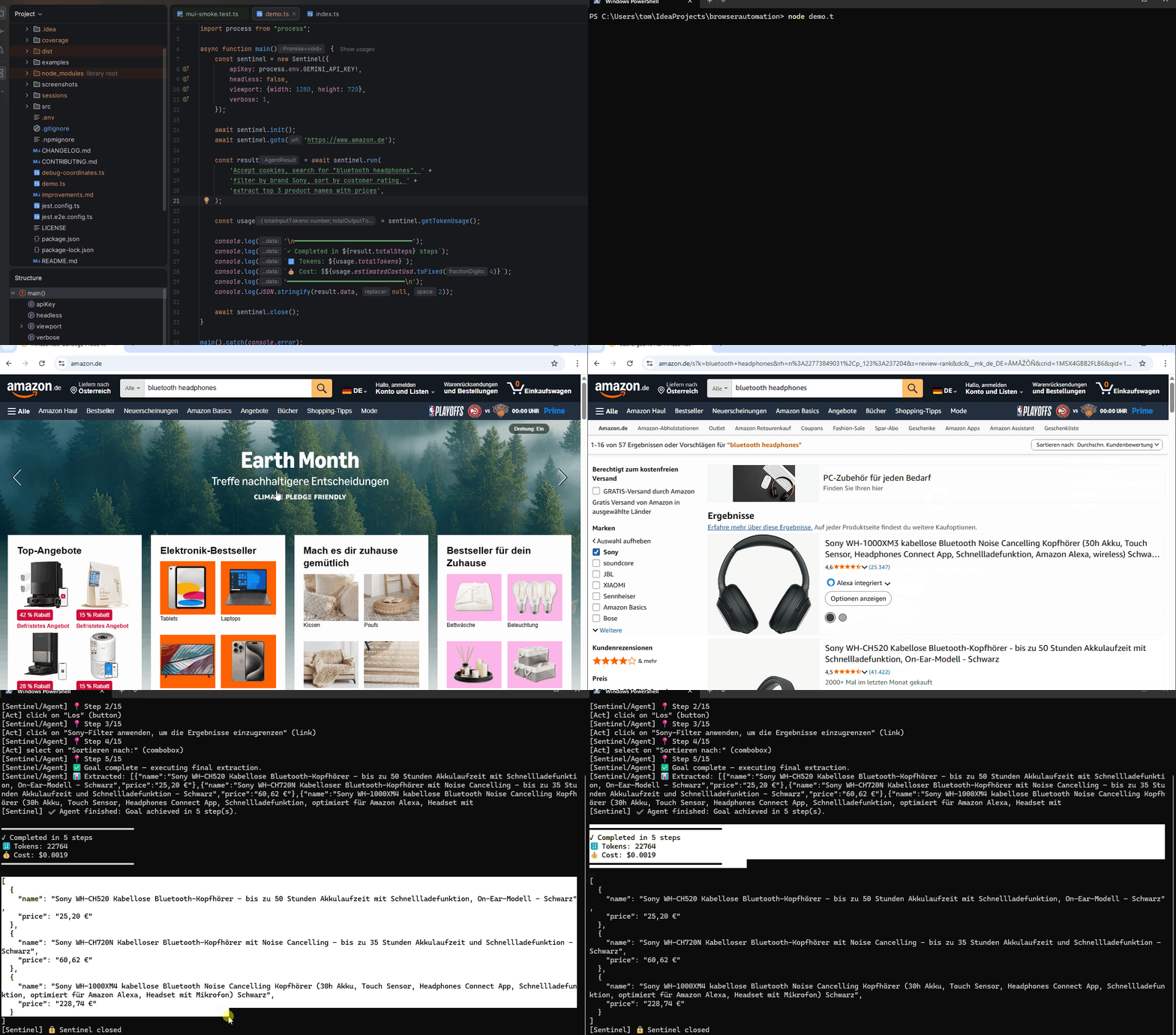
Running the same task with the same model (Gemini 3 Flash), Sentinel completed in 5 steps / under 20s / 23k tokens / $0.0019. Stagehand timed out at 300s+ with one decision call alone consuming 210k tokens.
Full benchmark methodology and raw data: isoldex.ai/benchmark
Features
act()— natural language actions (click, fill, select, scroll)extract()— structured data extraction with Zod schemasrun()— autonomous multi-step agent with goal-driven planningfillForm()— declarative form filling with one JSON objectintercept()— capture API responses instead of scraping DOM- MFA/TOTP — auto-generate 2FA codes during login flows
- CLI —
npx sentinel run "goal" --url https://... - MCP Server — use Sentinel from Claude Desktop, Cursor, or any MCP client (stdio or standalone HTTP transport)
run() and fillForm() both accept maxSteps, timeoutMs, and an AbortSignal
via their options. Cancellation and time budgets are checked between steps and
after planning, before the next browser action starts.
Credentials
Either a Gemini apiKey or a custom provider — the type system enforces one of them, and providers carry their own credentials:
new Sentinel({ apiKey: process.env.GEMINI_API_KEY! });
new Sentinel({
  provider: new OpenAIProvider({ apiKey: process.env.OPENAI_API_KEY!, model: 'gpt-4o' }),
});
new Sentinel({ provider: new OllamaProvider({ model: 'llama3.2' }) }); // no key at all
Use variables for anything secret. The placeholder is resolved for the browser but never for a cache, so a file-backed cache stores %password% rather than the value:
await sentinel.act('Fill %password% into the password field', {
  variables: { password: process.env.APP_PASSWORD! },
});
Cancelling a run
runStream() stops the agent as soon as you stop consuming it — a break, an exception, or an SSE client disconnecting. Pass signal to cancel from elsewhere (e.g. request.signal):
for await (const event of sentinel.runStream(goal, { signal })) {
  if (isEnough(event)) break; // agent halts; no further tokens are spent
}
MCP server over HTTP
Defaults to 127.0.0.1:3333 with no authentication, which is safe only because it is loopback-only: requests are rejected unless Host and any Origin are loopback. Exposing it further requires a token, and the server refuses to start without one.
All requests share one browser session, so tool calls are serialised. HTTP mode decouples the client from the process; it is not a way to serve concurrent users.
Documentation
- Getting Started
- API Reference
- Examples
- LLM Providers — OpenAI, Claude, Gemini, Ollama setup
- MCP Server
- Benchmark vs Stagehand
- Migrate from Stagehand
- Changelog
License
MIT