harken
Your agent cannot listen to audio. harken fixes that — locally.
An MCP server that transcribes WhatsApp voice notes, meeting recordings — any audio — so your agent can read them. One 13 MB binary powered by whisper.cpp, fully offline: no Python, no ffmpeg, no API key, nothing leaves the machine. The same binary is also a batch CLI and a Claude Code Agent Skill.
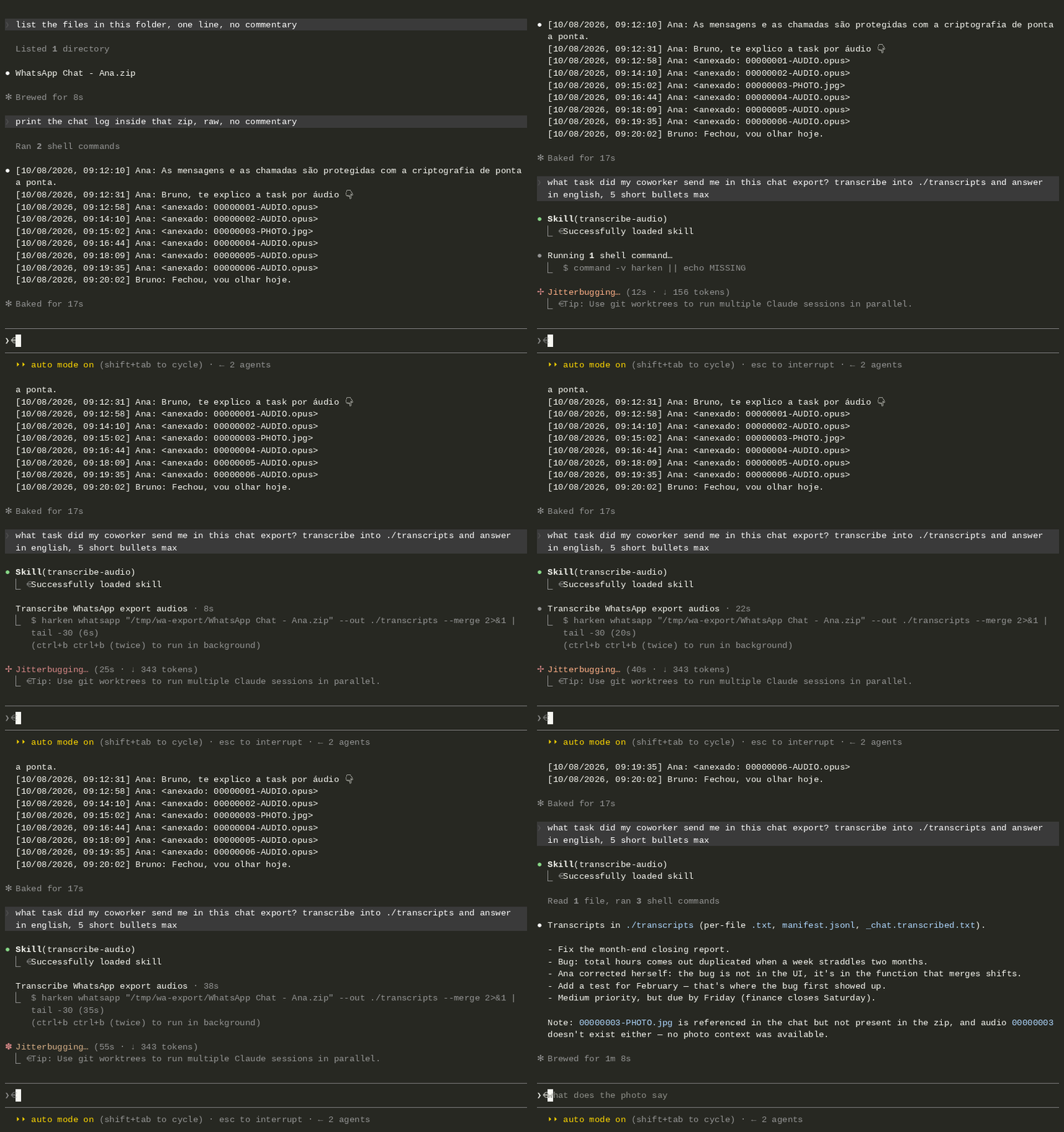
Five Portuguese voice notes explaining one task — transcribed on CPU, read by the agent, and answered in five bullets. Nothing left the machine.
Quickstart — give your agent ears
Install the binary (Linux/macOS; more options):
curl --proto '=https' --tlsv1.2 -LsSf https://github.com/montezuma-p/harken/releases/latest/download/harken-installer.sh | sh
Wire it into your MCP client:
claude mcp add harken -- harken mcp
or, in a project .mcp.json (Claude Code) / claude_desktop_config.json
(Claude Desktop):
{
  "mcpServers": {
    "harken": { "command": "harken", "args": ["mcp"] }
  }
}
That is the whole setup. Three tools appear — transcribe_file,
transcribe_whatsapp_export and transcribe_status — and any MCP client can
use them: Claude Code, Claude Desktop, Cursor, Windsurf. Hand the agent an
.opus, an .mp3, a whole WhatsApp chat-export zip; it transcribes locally
and reads the text. transcribe_status lets the agent check the model cache,
language and device without transcribing anything (it never touches the
network) — including whether the startup download is still in flight, so a
call that would simply wait is not mistaken for one that would stall.
The server speaks the current MCP revision, 2026-07-28 (stateless, with
server/discover), and still answers the initialize handshake of 2025-06-18
and older — so it works with clients on either side of that change.
Model, language and device are fixed per server instance (harken mcp --model medium --lang auto) with the same defaults as the CLI (small, pt, cpu) —
run two entries for two languages. On startup the server downloads an uncached
model in the background (~466 MB for small) while it already answers
initialize/tools/list; a tool call arriving mid-download waits for it. To
skip even that first-call wait, pre-warm the cache once:
harken warm # or: harken warm --model medium
Why
A coworker explains one task in five voice notes of 1–2 minutes each. That is ten minutes you have to sit through in order — and at the end you still cannot search it, quote it, or paste the one sentence that mattered into a ticket.
One 30-second note? Just listen to it. harken is for the rest:
- Agents cannot listen. You cannot hand an
.opusto Claude. Through the MCP server (or the Agent Skill), the agent transcribes the notes locally, reads them, and picks up the task context on its own — including the correction buried halfway through the notes. - Volume. Five notes in a row, a folder of meeting recordings, a whole WhatsApp chat export — one command, one model load, one folder of text.
- Text is random-access. Grep it, skim it, quote it, diff it. Audio at 2x is still serial — you cannot ctrl-F a voice note.
Voice notes, meeting recordings, and WhatsApp PTT audio are also often sensitive, so none of the above costs you privacy. Everything runs on your own machine: no audio and no transcript ever leaves the device, no API key, no upload step, no cloud dependency, CPU by default — no GPU required.
The Agent Skill — Claude Code
Beyond the MCP tools, harken ships an
Agent Skill that teaches Claude
Code when and how to transcribe audio locally instead of reaching for a cloud
API. Install it as a plugin:
/plugin marketplace add montezuma-p/harken
/plugin install harken@harken
The skill invokes the harken binary and knows how to install it with the
one-liner above if it is missing. (Alternatively: clone the repo and the
project-scoped skill in .claude/skills/ is picked up automatically, or
copy/symlink .claude/skills/transcribe-audio/ into ~/.claude/skills/.)
The CLI
The same engine, batch-first — point it at files, folders, globs, or a WhatsApp chat-export zip:

# One file → ./transcripts/voice-note.txt
harken voice-note.opus

# A whole folder, recursively; globs work too
harken ~/Downloads/meeting-recordings/
harken "recordings/*.m4a" --out ./out --format srt

# Every voice note in a WhatsApp export ("Export chat" → with media)
harken whatsapp "WhatsApp Chat with Maria.zip"

# Only a date range, plus a merged chat log with each transcript inlined
harken whatsapp export.zip --from 2026-07-01 --to 2026-07-15 --merge
Flags (both modes): --out DIR (default ./transcripts, or
./<zip-stem>-transcripts for exports), --model (default small), --lang
(default pt; auto to detect), --format (txt/json/srt/md),
--device (default cpu), --force (re-transcribe existing outputs).
WhatsApp mode adds --from/--to (YYYY-MM-DD, inclusive) and --merge,
which writes _chat.transcribed.txt: the full original chat with each voice
note's transcript inlined right under its message. Both iOS and Android export
formats are auto-detected, including day-first vs month-first Android dates.
Every file gets <out>/<stem>.<format>, and a running manifest.jsonl
records one line per transcription. Progress goes to stderr; the exit code is
1 if any file failed (skips don't count), 2 for input errors.
Privacy note: output files — transcripts and
manifest.jsonl— contain the full transcribed text. Keep your output dirs out of version control.
Install
One-liner (Linux/macOS):
curl --proto '=https' --tlsv1.2 -LsSf https://github.com/montezuma-p/harken/releases/latest/download/harken-installer.sh | sh
Windows (PowerShell):
powershell -ExecutionPolicy Bypass -c "irm https://github.com/montezuma-p/harken/releases/latest/download/harken-installer.ps1 | iex"
Other options:
cargo binstall harken        # prebuilt binary via cargo-binstall
cargo install harken --locked  # build from source (needs Rust 1.88+, cmake + a C++ toolchain)
Building from source with CMake >= 4 and no system libopus? The vendored opus tree declares an old CMake minimum; prepend
CMAKE_POLICY_VERSION_MINIMUM=3.5to thecargo installline.
Prebuilt binaries and default source builds target AVX2/FMA/F16C (Intel Haswell,
AMD Excavator, or newer). Building for the machine you are on, and want its full
instruction set? Prepend HARKEN_NATIVE=1 to the cargo install line.
If you are building from a git checkout, initialize the vendored whisper.cpp submodule first:
git clone --recurse-submodules https://github.com/montezuma-p/harken
# or, if you already cloned it:
git submodule update --init --recursive
Models & hardware
--model accepts a whisper.cpp ggml model
name or a path to a local .bin file:
small(default, ~466 MB) — good accuracy/speed tradeoff on CPU; fine for most voice notes and casual recordings.medium(~1.5 GB) — noticeably better accuracy (accents, background noise, technical vocabulary), at a real CPU time cost.- Quantized variants — append
-q5_0,-q5_1, or-q8_0to any name (e.g.small-q5_1, ~182 MB): ~60% smaller download, marginal quality loss. - Also:
tiny,base,large-v1,large-v2,large-v3,large-v3-turbo, and the.enEnglish-only variants.
With the default model, an hour of audio transcribes in ~22 minutes on a
2017 desktop CPU — no GPU involved. Measured on an Intel i5-7400 (4 threads),
10 minutes of synthetic Portuguese speech, single run, GNU time -v, model
download excluded (reproduce with make bench):
Table measured on v0.3.1. The v0.4.0 engine (in-repo FFI instead of
whisper-rs) came out within 3% of it in a controlled A/B on the same machine —
five interleaved pairs, small — so these numbers still describe the current
build. Single-run figures drift more than that between sessions, which is why
the comparison was done interleaved rather than by re-running the table.
The chosen model is downloaded once, on first use, to
~/.cache/harken/models. Subsequent runs reuse the cached model with no
network access.
CPU is the safe default everywhere — and today it is also the only backend:
no shipped binary compiles GPU support, so passing --device with anything
other than cpu prints a warning and runs on CPU. GPU offload
(Metal/CUDA/Vulkan) would require building from source with a modified
build.rs; none of the release targets do.
Development
make check # fmt + clippy + tests + cargo-audit + cargo-machete
Tests never load a real Whisper model — the transcription engine is a trait, and the suite runs against a fake, so it is instant and offline. Architecture map: docs/ARCHITECTURE.md.
License
Licensed under either of
- Apache License, Version 2.0 (LICENSE-APACHE or https://www.apache.org/licenses/LICENSE-2.0)
- MIT license (LICENSE-MIT or https://opensource.org/licenses/MIT)
at your option.
Bundles whisper.cpp (MIT) as the
pinned submodule at vendor/whisper.cpp, compiled into the binary — see
its license.
Unless you explicitly state otherwise, any contribution intentionally submitted for inclusion in the work by you, as defined in the Apache-2.0 license, shall be dual licensed as above, without any additional terms or conditions.