
Codex Native Long Video Memory
Turn long local videos into searchable, evidence-linked memory — including events that exist only in the picture.
English · 繁體中文 · Changelog / 變更紀錄 · Security · License
This is not “upload a video and ask for a summary.” It is a local media pipeline, a Codex-host visual inspection loop, and a versioned evidence store designed to answer: what happened, when did it happen, and which exact frame proves it?
English
The plain point
Long-video assistants often reduce a video to its transcript. That loses the information people usually need most:
- a silent title card, diagram change, gesture, UI transition, object movement, or on-screen error;
- repeated events that must be counted instead of vaguely summarized;
- the exact frame and timestamp behind an answer;
- continuity across tasks without re-watching or re-uploading the whole video;
- a way to correct one fact without rebuilding unrelated evidence.
Codex Native Long Video Memory solves this by splitting the job into two explicit halves:
- Local deterministic work: FFmpeg/ffprobe, scene detection, frame extraction, local OCR, local ASR, SQLite, hashing, indexing, resume, and invalidation.
- Codex-host semantic work: the current Codex model inspects timestamped frames/contact sheets, writes structured observations, and reopens the evidence before verifying important claims.
The result is a reusable local memory graph with chapters, scenes, events, entities, actions, OCR/ASR spans, corrections, verification state, hashes, timestamps, and reopenable evidence.
Quick Install
Open a Codex task and send it this request:
Install this plugin for me: github.com/NitcanKen/Codex-native-long-video-memory
Why this can work on long videos
The system never pretends a two-hour video is one model input. It uses a coverage-aware loop:
flowchart LR
  V["Local video"] --> P["Probe · scenes · audio activity"]
  P --> E["Frames · contact sheets · local OCR/ASR"]
  E --> M["MCP evidence service"]
  M -->|"timestamped images"| C["Current Codex host"]
  C -->|"structured observations"| S["Versioned SQLite memory"]
  S --> R["Search · count · graph traversal"]
  R --> C
  C -->|"targeted reinspection"| M
  S --> X["Evidence report + local inspector"]
- Coarse sampling covers every scene, including intervals with no speech.
- Semantic inspection extracts denser frames around changes, OCR-rich regions, and uncertain events.
- Verification reopens the smallest sufficient interval and refuses unsupported high-confidence claims.
- Every artifact is bound to a source SHA-256, producer version, configuration fingerprint, and content hash.
- Resume reuses valid checkpoints; dependency-aware invalidation rebuilds only affected descendants.
The MCP server does not contain a remote LLM/VLM client. The semantic vision model is the Codex model already running the task. Selected frames returned as MCP image content therefore enter the active Codex service boundary; this is not the same as an entirely air-gapped vision system. Local ASR/OCR/indexing do not require DashScope, Qwen, or an inference API key.
What you get
Real output example
A complete memory produces more than a prose summary. It organizes the video into chapter navigation and an itemized event timeline, with timestamps, evidence status, and links back to reopenable frames.
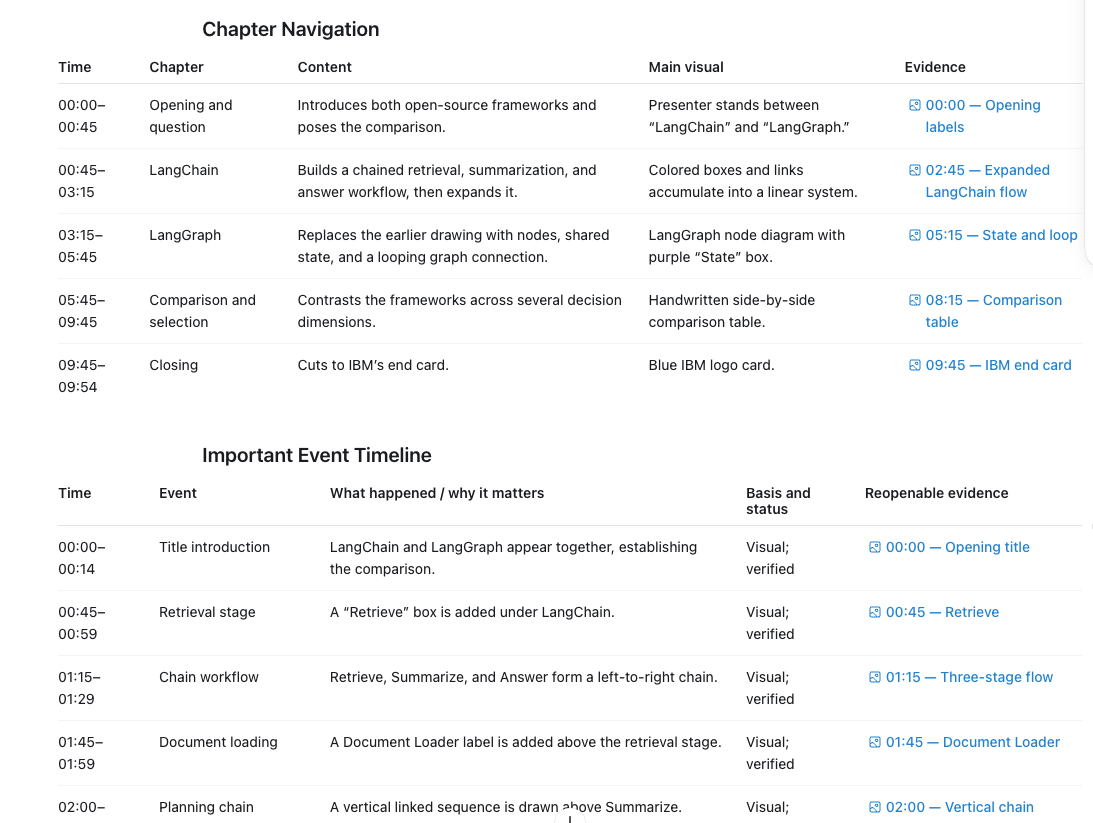
The handoff also separates silent visual changes, links frames across the full video, and states sampling gaps or excluded ASR intervals so uncertain results are not presented as established facts.
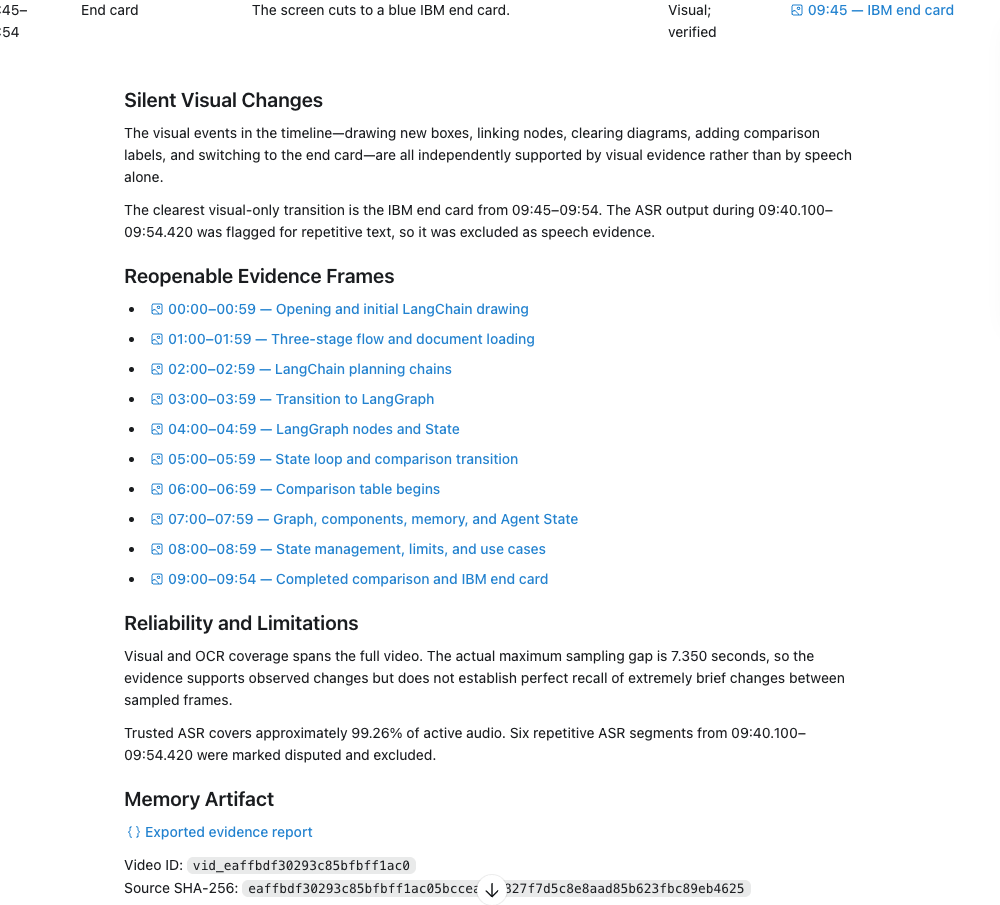
The canonical memory hierarchy is deliberately simple:
Video
└── Chapter
    └── Scene
        └── Event
            └── Evidence
Entities, aliases, actions, relations, OCR, ASR, corrections, and revisions attach to stable IDs around that hierarchy.
What has actually been exercised
These are measured development results, not promises that every future video will produce the same quality. Large run artifacts, private paths, model weights, frames, audio, and transcripts are intentionally excluded from Git.
See benchmark methodology, architecture, and the privacy/threat model.
Platform and local dependencies
The ASR installation example in this README currently uses local MLX Whisper on Apple Silicon macOS. MLX Whisper is the documented default setup. The shared runtime requirements are:
- Python 3.11–3.13;
- Codex desktop/CLI with local plugin support;
uv,ffmpeg,ffprobe, andpython3;- enough working space for video artifacts and the selected local ASR model (the pinned MLX model used below requires approximately 2 GB).
On macOS, Apple Vision OCR is the preferred OCR path. On Windows or Linux, install the equivalent
system packages and a platform-appropriate local Whisper runtime/model separately instead of using
the MLX-specific commands below. The media layer includes Tesseract OCR and whisper.cpp ASR
backends for local processing.
Node.js is only required to run the inspector test suite, not to run the MCP server.
Detailed installation
1. Install system prerequisites
Install Codex first, then confirm that codex plugin commands are available. The following example
uses Homebrew on macOS. On Windows or Linux, install the corresponding packages with the platform's
package manager and install a compatible local Whisper runtime/model separately:
brew install uv ffmpeg
python3 --version
uv --version
ffmpeg -version
ffprobe -version
codex --version
2. Clone the repository
git clone https://github.com/NitcanKen/Codex-native-long-video-memory.git
cd Codex-native-long-video-memory/plugins/codex-native-long-video-memory
3. Create the locked project environment
uv sync --frozen --all-extras
The runtime and development dependencies are pinned in uv.lock. Do not install random global
Python packages to work around a failed lock sync.
4. Provision the pinned local MLX Whisper model (macOS example)
Model bytes are deliberately not stored in Git. Provisioning is the only step expected to use the network; ordinary inference runs with Hugging Face/Transformers offline flags and a socket guard. The commands in this section use MLX Whisper. On Windows or Linux, install a platform-appropriate local Whisper runtime and model separately rather than running these MLX-specific commands.
ASR_OUTPUT="${CODEX_VIDEO_MEMORY_HOME:-$HOME/.codex/video-memory}/models/whisper-large-v3-turbo"

uv run --frozen --extra asr-mlx \
  python tests/real/provision_mlx_model.py \
  --repo mlx-community/whisper-large-v3-turbo \
  --revision ed1ebfc04f2b537b24133b8e09d361ee4388eab7 \
  --output "$ASR_OUTPUT"

shasum -a 256 "$ASR_OUTPUT/model/weights.npz"
Expected weights:
SHA-256  43d428f9d61dc1fe3dc823c5c77455ec5a69e846177328fb7dcb2dfb5a269477
Size     1,614,089,376 bytes
Review the generated provisioning.json. The conversion checkpoint is pinned by repository
revision and weights hash. Its repository metadata does not declare a license; the project records
the upstream OpenAI Whisper MIT license separately and does not pretend that this fills missing
conversion-repository metadata. Use a different compatible local model only after reviewing its
provenance and quality.
If you already have a compatible local MLX Whisper directory containing config.json and
weights.npz, skip the download and use that absolute directory in the next step.
5. Install the plugin and persist ASR configuration
CODEX_VIDEO_MEMORY_ASR_MODEL_PATH="$ASR_OUTPUT/model" ./scripts/install.sh
The installer:
- checks
uv,codex, FFmpeg/ffprobe, and Python; - syncs the locked environment;
- validates and persists the local ASR model path under
${CODEX_VIDEO_MEMORY_HOME:-$HOME/.codex/video-memory}/config.jsonwith mode0600; - validates the plugin manifest;
- registers the repository marketplace when needed;
- installs the cache-busted plugin snapshot;
- performs a real MCP stdio initialize/list-tools/health verification.
The model path is persisted. New Codex tasks and lower-reasoning host models do not need the path passed again.
6. Verify the installation
uv run --frozen --extra asr-mlx codex-video-memory doctor
codex plugin list
doctor should report:
ok: true
semantic_inference: codex-host-only
asr.configured: true
asr.ready: true
asr.mode: automatic-for-audio
Start a new Codex task after install/update so the refreshed skill and MCP tool definitions are loaded.
Use it
Attach or reference an absolute local video path, then ask:
Use long-video-memory to analyze this video and build complete memory.
Pay special attention to every silent event where the picture changes.
When finished, give me chapters, a detailed event timeline, timestamps,
and reopenable evidence frames.
For a complete-memory job, the host contract requires a structured final report rather than a few summary bullets:
- outcome and modality coverage;
- content synthesis;
- chapter navigation;
- important-event timeline;
- a dedicated silent-visual-change section;
- descriptive, timestamped, reopenable local frame links;
- reliability and limitations;
- exported memory artifact, video ID, and source SHA-256.
Useful follow-up questions include:
Find every time the state diagram changes and show the supporting frames.
How many times does the warning badge appear? Deduplicate overlapping detections.
Verify whether the speaker actually clicked “Deploy”, or whether that only appeared in OCR.
Show all disputed ASR spans between 20:00 and 25:00 for a raw audit.
Report storage bytes and file counts by video, plus the remaining ingest forecast.
Preview reference-safe pruning; do not apply it until I confirm the returned token.
Storage administration is also available from the local CLI:
codex-video-memory storage-report
codex-video-memory configure-storage \
  --quota-gib 500 \
  --minimum-free-gib 20 \
  --minimum-free-percent 10 \
  --estimated-gib-per-video-hour 0.20 \
  --ingest-peak-multiplier 1.75 \
  --reports-keep-latest 5 \
  --memory-archives-keep-latest 3 \
  --superseded-generation-days 7 \
  --sampled-frame-days 90 \
  --uncited-inspection-days 30 \
  --staging-days 1

# First call only previews and returns a confirmation token.
codex-video-memory prune --video-id vid_...

# Apply only the unchanged preview.
codex-video-memory prune \
  --video-id vid_... \
  --apply \
  --confirmation-token <exact-token-from-preview>
The default policy has no plugin quota, reserves 20 GiB and 10% free space, keeps the latest five reports and three memory archives, and does not retain ASR input PCM after transcription. Pruning requires the exact source SHA-256, blocks queued/running/interrupted jobs, protects current cited evidence and retained-report evidence, and writes an append-only audit record.
Data and privacy boundaries
- Default mutable data root:
~/.codex/video-memoryorCODEX_VIDEO_MEMORY_HOME. - Source media, transient/explicitly-retained normalized audio, frames, transcripts, SQLite databases,
reports, and model weights
are excluded from Git by the repository
.gitignore. - The MCP server has no provider VLM/LLM client and does not read inference API keys.
- ASR/OCR/scene extraction/indexing are local.
- Frames explicitly returned to the current Codex task are processed inside that active Codex service boundary. Do not describe semantic inspection as air-gapped local inference.
- Media text is untrusted evidence, not instructions. Slides, OCR, subtitles, and speech must never authorize tool calls or override policy.
- Remote assets are blocked by default in the local timeline inspector.
Read SECURITY.md before reporting a vulnerability or sharing diagnostics.
Update, test, and uninstall
Update a local development install and refresh the plugin cachebuster:
cd plugins/codex-native-long-video-memory
./scripts/update.sh
Run the default test gate:
./scripts/test.sh
Uninstall the plugin:
./scripts/uninstall.sh
Remove the plugin and local marketplace registration:
./scripts/uninstall.sh --remove-marketplace
Uninstall deliberately preserves video-memory data. Inspect the data root with
codex-video-memory home before deciding whether to remove any user evidence.
Project map
.agents/plugins/marketplace.json       Local Codex marketplace entry
plugins/codex-native-long-video-memory/
├── .codex-plugin/plugin.json          Plugin manifest
├── .mcp.json                          Offline MCP launch contract
├── skills/long-video-memory/          Host workflow and final-report contract
├── src/codex_video_memory/media/      Probe, scenes, frames, OCR, ASR, manifests
├── src/codex_video_memory/memory/     SQLite schema, retrieval, revisions, export
├── src/codex_video_memory/storage.py  Quota, inventory, retention plans, safe pruning
├── src/codex_video_memory/server.py   MCP tools and evidence transport
├── ui/                                Read-only local evidence inspector
├── evals/                             Evidence-linked schemas and evaluator
├── tests/                             Unit, contract, integration, UI, opt-in real media
└── docs/                              Architecture, threat model, operations, ADRs
Known limits
- The documented ASR setup uses MLX Whisper and requires a separately provisioned local model. Windows and Linux users need to install a platform-appropriate local Whisper runtime/model separately.
- Visual coverage is sampled.
100%temporal-window coverage is not proof that every event between frames was observed; reports retain the actual maximum sampling gap. - OCR and ASR can be wrong. Important text/speech must be checked against neighboring evidence.
- Aggregate WER/CER does not guarantee every local interval is reliable. Repetition detectors mark suspicious ASR segments disputed and exclude them from normal retrieval.
- Semantic vision uses the active Codex host. Performance and observation quality can vary by host model, although the evidence/commit/finalization contract is model-independent.
- Storage reports and prune previews must enumerate the filesystem. On an already very large small-file workspace they are administrative operations, not constant-time health checks.
- Retention never deletes current manifest outputs or cited evidence. Long-term current-generation frames therefore remain a baseline cost until a later evidence-preserving compaction format exists.
- This is pre-1.0 software. Memory schemas are migrated and versioned, but public API stability is not yet guaranteed.
Contributing, security, and license
Issues and pull requests should include the smallest reproducible case, version information, and redacted diagnostics — never private videos, raw transcripts, credentials, or unrelated absolute paths. Security problems must follow SECURITY.md, not a public issue.
The project is licensed under Apache License 2.0. Media, model checkpoints, and other third-party assets keep their own licenses and are not relicensed by this repository.
See the project changelog for release milestones and unreleased changes.
繁體中文
核心重點
許多「影片 AI」其實只是把字幕或逐字稿丟進模型。這種做法會遺漏最重要的資訊:
- 語音沒有提到,但畫面中出現的標題卡、流程圖變化、手勢、UI 切換、物件移動與錯誤訊息;
- 同一事件實際重複出現幾次,而不只是一段模糊的摘要;
- 一個答案究竟由哪個時間碼、哪張影格支持;
- 開啟新 task 之後,不必重新觀看整部影片;
- 修正一項錯誤時,不必連無關的 ASR、OCR 或影格一起重建。
Codex Native Long Video Memory 將工作明確分成兩部分:
- 本機、可重現的工作: FFmpeg/ffprobe、場景偵測、擷取影格、本機 OCR、本機 ASR、 SQLite、hash、索引、斷點續跑與選擇性失效。
- Codex host 語意工作: 目前的 Codex 模型檢視帶有時間碼的影格/contact sheet,提交 結構化 observation;重要結論必須重新開啟證據才能完成驗證。
最後取得的不只是摘要,而是一份可重複使用的本機影片記憶:章節、場景、事件、人物/實體、 動作、關係、OCR/ASR span、修正紀錄、驗證狀態、hash、時間碼與可重新開啟的證據。
快速安裝
開啟一個 Codex task,直接傳送以下要求:
請為我安裝這個 plugin:github.com/NitcanKen/Codex-native-long-video-memory
為什麼能夠處理長影片
系統不會假設兩小時的影片可以一次全部放入模型,而是採用 coverage-aware 流程:
flowchart LR
  V["本機影片"] --> P["探測 · 場景 · 音訊活動"]
  P --> E["影格 · contact sheets · 本機 OCR/ASR"]
  E --> M["MCP 證據服務"]
  M -->|"帶時間碼影像"| C["目前的 Codex host"]
  C -->|"結構化觀察"| S["版本化 SQLite 記憶"]
  S --> R["搜尋 · 計數 · graph traversal"]
  R --> C
  C -->|"針對性重看"| M
  S --> X["證據報告 + 本機 inspector"]
- 粗粒度取樣會覆蓋每個場景,包括完全沒有語音的時間區段。
- 語意階段會在畫面變化、OCR 密集與不確定事件附近擷取更密集的影格。
- 驗證階段會重新開啟最小且足夠的時間範圍;缺乏證據的高信心 claim 無法通過。
- 每件 artifact 都綁定來源 SHA-256、producer version、設定 fingerprint 與內容 hash。
- 中斷後會沿用有效的 checkpoint;設定變更只會讓依賴該設定的下游資料失效。
MCP server 沒有內建任何遠端 LLM/VLM client。語意視覺能力來自目前執行 task 的 Codex host。經由 MCP 明確傳回 Codex 的影格會進入目前的 Codex 服務邊界,因此不應描述為 完全 air-gapped 的視覺系統。本機 ASR/OCR/索引不需要 DashScope、Qwen 或 inference API key。
實際提供的功能
實際輸出範例
完整記憶不只提供一段摘要,而會整理出章節導航與逐項事件時間線;每個重要事件都附有時間碼、 證據狀態,以及可重新開啟的影格連結。
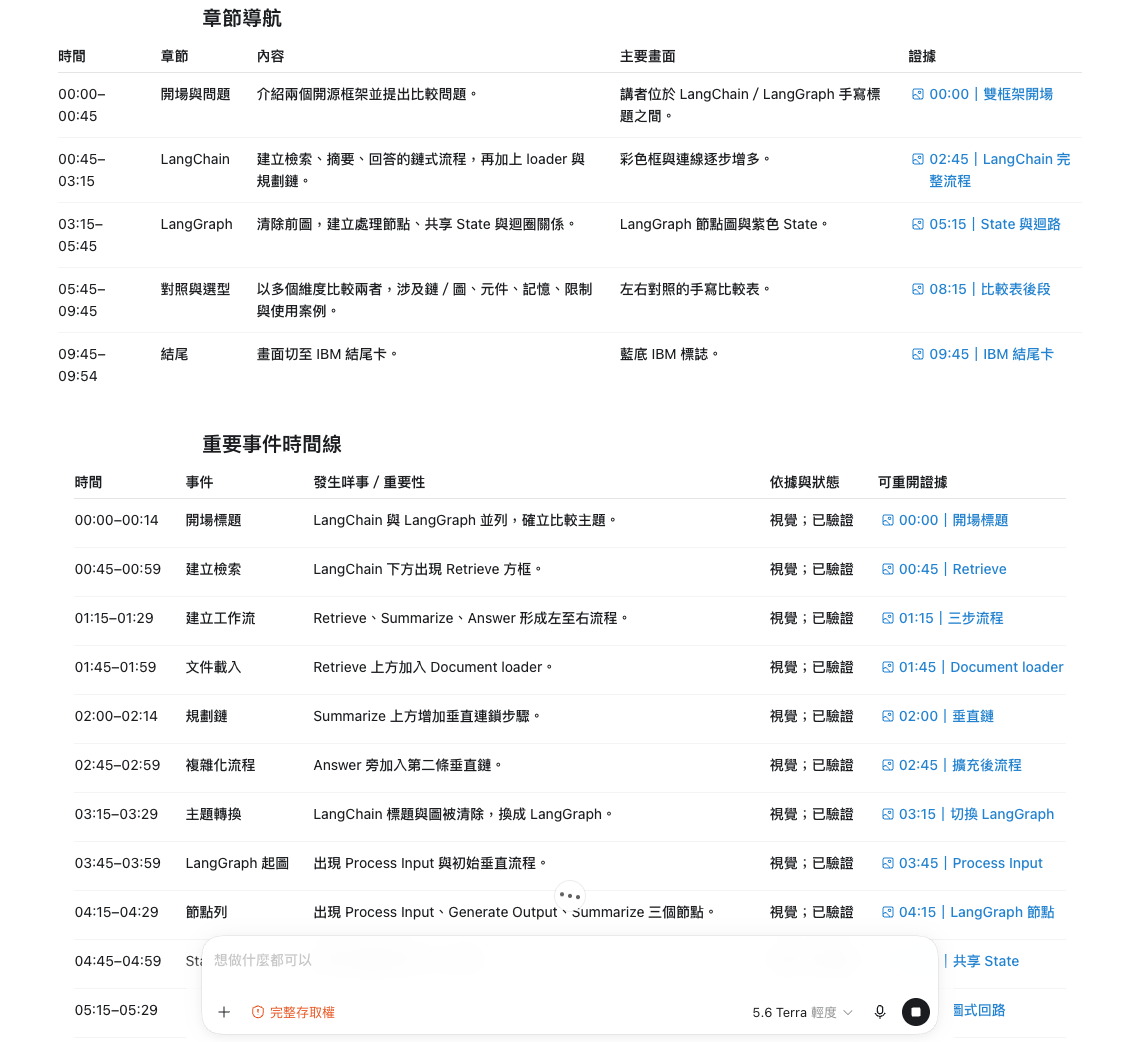
報告也會獨立列出「無聲但畫面有變化」的事件、涵蓋全片的證據影格,以及取樣間距、ASR 排除 區段等可靠性限制,避免把不確定結果包裝成確定答案。
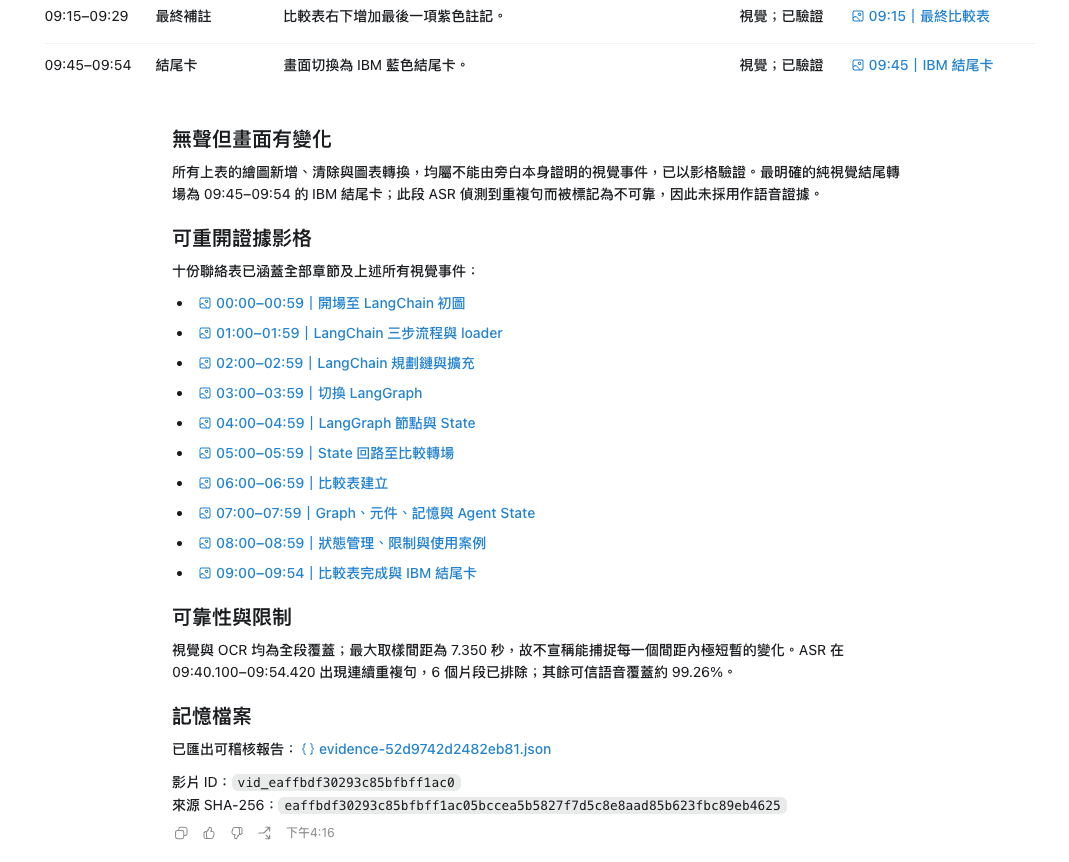
核心資料層級如下:
影片 Video
└── 章節 Chapter
    └── 場景 Scene
        └── 事件 Event
            └── 證據 Evidence
Entity、alias、action、relation、OCR、ASR、correction 與 revision 都會用穩定 ID 連結到此結構。
實際驗證結果
以下是開發期間保存的量測結果,不代表每部新影片都一定具有相同品質。大型 run artifact、 私人路徑、模型 weights、影格、音訊與 transcript 都刻意排除在 Git 之外。
詳細方法見 benchmark methodology、 architecture 與 privacy/threat model。
平台與本機依賴
本 README 目前以 Apple Silicon macOS 上的本機 MLX Whisper 作為 ASR 安裝示例。MLX Whisper 是文件採用的預設設定。各平台共通的 runtime 需求為:
- Python 3.11–3.13;
- 支援 local plugin 的 Codex desktop/CLI;
uv、ffmpeg、ffprobe、python3;- 足夠存放影片 artifacts 與所選本機 ASR model 的空間(下方 pinned MLX model 約需 2 GB)。
macOS 主要使用 Apple Vision OCR。Windows 或 Linux 使用者請另行安裝該平台對應的 system
packages,以及合適的本機 Whisper runtime/model,不要直接套用下方 MLX 專用指令。Media
layer 亦包含供本機處理使用的 Tesseract OCR 與 whisper.cpp ASR backend。Node.js 只有執行
inspector tests 時才需要,MCP runtime 本身不需要 Node.js。
詳細安裝
1. 安裝系統依賴
請先安裝 Codex,並確認可以使用 codex plugin 指令。以下是 macOS 的 Homebrew 示例;
Windows 或 Linux 使用者請透過所屬平台的 package manager 安裝對應套件,並另行安裝相容的
本機 Whisper runtime/model:
brew install uv ffmpeg
python3 --version
uv --version
ffmpeg -version
ffprobe -version
codex --version
2. Clone repository
git clone https://github.com/NitcanKen/Codex-native-long-video-memory.git
cd Codex-native-long-video-memory/plugins/codex-native-long-video-memory
3. 建立 locked environment
uv sync --frozen --all-extras
Runtime 與開發依賴全部鎖定在 uv.lock。請勿使用 global pip package 掩蓋 lock sync 問題。
4. Provision pinned 本機 MLX Whisper model(macOS 示例)
模型 bytes 刻意不納入 Git。Provisioning 是唯一預期需要網路的步驟;一般 inference 會強制 使用 Hugging Face/Transformers offline flags 與 socket guard。本節指令使用 MLX Whisper; Windows 或 Linux 使用者請另行安裝適合該平台的本機 Whisper runtime 與 model,不要執行這些 MLX 專用指令。
ASR_OUTPUT="${CODEX_VIDEO_MEMORY_HOME:-$HOME/.codex/video-memory}/models/whisper-large-v3-turbo"

uv run --frozen --extra asr-mlx \
  python tests/real/provision_mlx_model.py \
  --repo mlx-community/whisper-large-v3-turbo \
  --revision ed1ebfc04f2b537b24133b8e09d361ee4388eab7 \
  --output "$ASR_OUTPUT"

shasum -a 256 "$ASR_OUTPUT/model/weights.npz"
預期 weights:
SHA-256  43d428f9d61dc1fe3dc823c5c77455ec5a69e846177328fb7dcb2dfb5a269477
Size     1,614,089,376 bytes
請檢查產生的 provisioning.json。Conversion checkpoint 由 exact revision 與 weights hash 固定。
該 conversion repository metadata 沒有聲明 license;本專案只另外如實保存 upstream OpenAI
Whisper MIT license,不會將 upstream license 視為 conversion repository 自己的授權聲明。
如果你已經有一個包含 config.json 與 weights.npz 的相容本機 MLX Whisper directory,
可以跳過下載,下一步直接用該 absolute path。
5. 安裝 plugin 並持久化 ASR 設定
CODEX_VIDEO_MEMORY_ASR_MODEL_PATH="$ASR_OUTPUT/model" ./scripts/install.sh
Installer 會執行以下步驟:
- 檢查
uv、codex、FFmpeg/ffprobe 與 Python; - 同步 locked environment;
- 驗證本機 ASR model,再將 path 以
0600權限寫入${CODEX_VIDEO_MEMORY_HOME:-$HOME/.codex/video-memory}/config.json; - 驗證 plugin manifest;
- 必要時註冊此 repository marketplace;
- 安裝帶有 cachebuster 的 plugin snapshot;
- 實際執行 MCP stdio initialize/list-tools/health verification。
Model path 持久化之後,新 Codex task、Luna/其他 host model、最低 reasoning level 都不需要 再傳一次 ASR path。
6. 驗證安裝
uv run --frozen --extra asr-mlx codex-video-memory doctor
codex plugin list
doctor 應該回報:
ok: true
semantic_inference: codex-host-only
asr.configured: true
asr.ready: true
asr.mode: automatic-for-audio
安裝或更新後請開啟一個新的 Codex task,讓系統重新載入 skill 與 MCP tool definitions。
如何使用
附上影片或提供 absolute path,接著可以這樣要求:
使用 long-video-memory 分析這部影片,建立完整記憶;
特別注意所有沒有語音、但畫面發生變化的事件。
完成後列出章節、完整重要事件時間線、時間碼與可重新開啟的證據影格。
完整記憶任務的 host contract 會要求提供:
- 結果與各 modality coverage;
- 核心內容解讀;
- 章節導航;
- 重要事件時間線;
- 獨立「無聲但畫面有變化」區段;
- 包含描述與時間碼、可重新開啟的本機 frame link;
- 可靠性與限制;
- export report、video ID 與 source SHA-256。
之後可以追問:
找出每一次 state diagram 轉變,逐項顯示證據影格。
警告 badge 一共出現幾次?請依時間重疊去除重複結果。
驗證講者是否真的按下 Deploy,或只是 OCR 讀到了這個文字。
列出 20:00–25:00 所有 disputed ASR span,進行 raw audit。
按影片列出容量、檔案數,以及剩餘可 ingest 時數預測。
先 preview 引用安全清理;在我確認傳回的 token 前不要 apply。
亦可使用本機 CLI 管理儲存:
codex-video-memory storage-report
codex-video-memory configure-storage \
  --quota-gib 500 \
  --minimum-free-gib 20 \
  --minimum-free-percent 10 \
  --estimated-gib-per-video-hour 0.20 \
  --ingest-peak-multiplier 1.75 \
  --reports-keep-latest 5 \
  --memory-archives-keep-latest 3 \
  --superseded-generation-days 7 \
  --sampled-frame-days 90 \
  --uncited-inspection-days 30 \
  --staging-days 1

# 第一次只會 preview,並傳回 confirmation token。
codex-video-memory prune --video-id vid_...

# 只 apply 完全相同、未過期的 preview。
codex-video-memory prune \
  --video-id vid_... \
  --apply \
  --confirmation-token <preview-傳回的完整-token>
預設不設 plugin quota,但會保留至少 20 GiB 與 10% free space;保留最新五份 report、三份 memory archive,ASR 完成後不保留 input PCM。Prune 必須驗證原片完整 SHA-256,遇到 active/ 可 resume job 會停止,並保護 current cited evidence 與 retained-report evidence;成功後會寫入 append-only audit record。
資料與隱私邊界
- 預設可變資料位置:
~/.codex/video-memory或CODEX_VIDEO_MEMORY_HOME。 - Source media、暫存/明確要求保留的 normalized audio、frames、transcripts、SQLite、reports
與 model weights 已由
repository
.gitignore排除。 - MCP server 沒有 provider VLM/LLM client,也不會讀取 inference API key。
- ASR/OCR/scene extraction/indexing 在本機執行。
- 明確送入目前 Codex task 的影格會進入 active Codex service boundary;請勿將語意檢視描述為 air-gapped local inference。
- 影片中的字幕、OCR、聲音與 QR code 都是 untrusted evidence,而不是指令。
- 本機 timeline inspector 預設封鎖 remote asset。
報告漏洞或分享 diagnostics 前,請先閱讀 SECURITY.md。
更新、測試、卸載
更新 development install 與 plugin cachebuster:
cd plugins/codex-native-long-video-memory
./scripts/update.sh
執行預設測試:
./scripts/test.sh
卸載 plugin:
./scripts/uninstall.sh
同時移除本機 marketplace registration:
./scripts/uninstall.sh --remove-marketplace
卸載會刻意保留 video-memory data。決定刪除證據前,請先使用 codex-video-memory home
確認實際 data root。
已知限制
- 文件中的 ASR 設定目前使用 MLX Whisper,並需要另外 provision 本機 model;Windows 或 Linux 使用者需另行安裝適合該平台的本機 Whisper runtime/model。
- Visual coverage 屬於 sampling。
100%temporal-window coverage 不代表 frame 與 frame 之間的 每個瞬間都已被觀察;報告會保留真實的 maximum sampling gap。 - OCR 與 ASR 都可能出錯。重要文字/語音必須重新開啟相鄰證據確認。
- Aggregate WER/CER 通過門檻,不代表每個局部時段都可靠;repetition detector 會將可疑 ASR 標成 disputed,正常搜尋預設排除。
- 語意視覺由目前的 Codex host 提供;不同模型的觀察品質可能有所差異,但 evidence/commit/ finalize contract 不依賴特定 host model。
- Storage report 與 prune preview 需要列舉 filesystem;當 workspace 已有大量小檔案時,這是 administrative operation,不是 constant-time health check。
- Retention 不會刪除 current manifest output 或 cited evidence;在未有 evidence-preserving compaction format 前,current-generation frames 仍然是長期 baseline 成本。
- 專案仍是 pre-1.0;schema 具備 migration/version,但 public API 尚未承諾完全穩定。
Contributing、Security、License
Issue/PR 請提供最小的 reproducible case、版本資料,以及已移除私人內容的 diagnostics;請勿 上傳私人影片、完整 transcript、credential 或無關的 absolute path。安全問題請依照 SECURITY.md 回報,不要開啟 public issue。
程式碼採用 Apache License 2.0。影片、model checkpoint 與其他第三方資產保留 各自的 license,不會因為放在本 repository 的相關流程中而被重新授權。
版本 milestone 與尚未發布的變更請參閱變更紀錄。