9lives runner
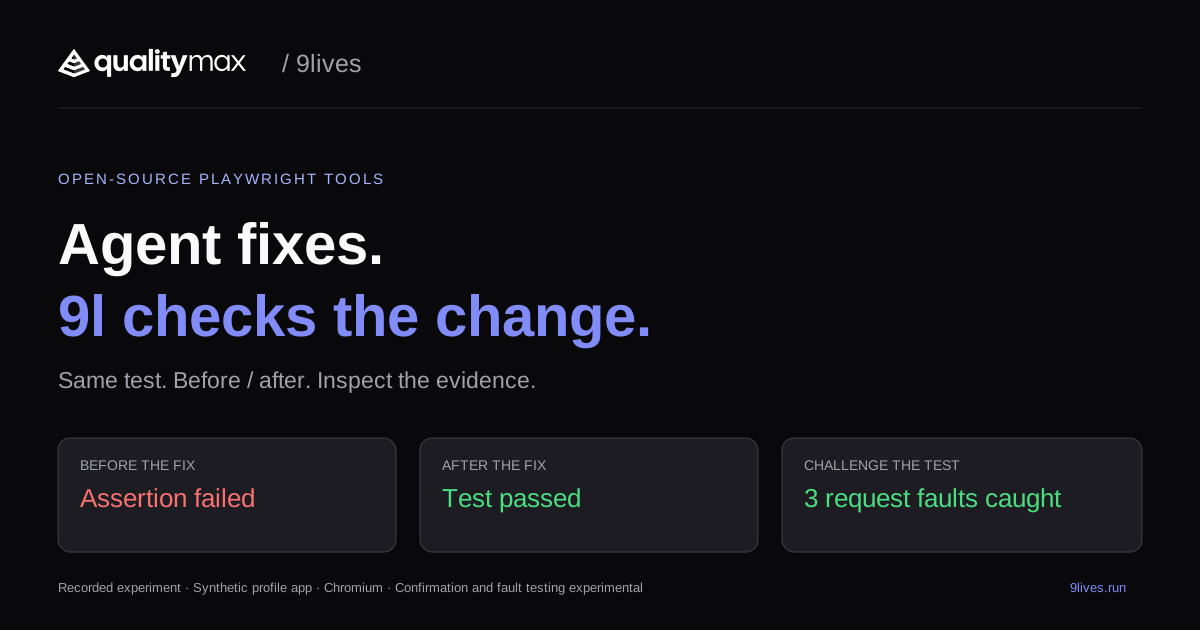
Your coding agent proposes a fix. 9lives runs the test, compares the results, and records what its assertions caught. Keep your Playwright suite and inspect the evidence locally. No QualityMax account or hosted service required.
Quickstart · Runnable first example · Interactive demo · Website · Memes · Documentation · npm SDK · CLI releases
Inspect a real experiment
The demo leads with an application fix: the same reviewed test fails before the patch and passes after it. Experimental fix confirmation compares the two Git revisions. Three injected request faults then each cause an assertion failure. Inspect the patch, scroll the console, and download the evidence extracts.
The last experiment records seven Chromium executions on one synthetic profile app, captured on 13 October 2026. Opening the demo does not execute tests or call an agent. It works in light and dark themes and as a single offline HTML file. To execute the eight-chapter lab yourself, follow the release lab guide. The earlier Demo Bank locator repair is also reproducible.
From CLI v0.4.8, run 9l doctor from the application project before the
first scan. It checks
local prerequisites and gives repair commands without downloading browsers or
loading project config. Use 9l doctor --sdk for SDK runs. See the
setup diagnostics guide for limits and first-run steps.
From a failure to a checked fix
- Reproduce: run a reviewed Playwright spec with an assertion that fails on the broken app.
- Review: inspect your agent's proposed application patch or locator repair; preserve the intended behavior.
- Confirm: experimental
9l confirm/ MCPconfirm_findingruns the same reproduction on each Git revision in isolation. - Challenge: experimental
9l proveinjects supported fetch/XHR faults and reruns the test.
A passing receipt means the assertions passed and the execution report was validated. Confirmation shows that the test distinguishes the revisions. A caught fault means an assertion failed under that fault. None establishes full requirement coverage. See the confirmation and fault testing contracts.
Run your existing Playwright tests
Install the native CLI on macOS or Linux:
curl -fsSL https://9lives.run/install.sh | sh
export PATH="$HOME/.local/share/9lives-runner/bin:$PATH"
9l plan tests/checkout.spec.ts --format json
9l run tests/checkout.spec.ts --timeout 2m --attempts 1 --format json
Run from your project root and replace the path with an existing spec. Follow the quickstart for prerequisites, expected results and troubleshooting, or try the synthetic fault example.
Your project supplies its Playwright dependencies, browsers, configuration, and assertions. The SDK is optional. Native v0.5.3 binaries support macOS, Linux and Windows on x64 and ARM64. See Windows ZIP installation and the existing-project guide. Chromium is qualified; other browser engines are unqualified.
Connect the tools to a coding agent through native MCP. For Claude Code:
claude mcp add 9lives -- 9l mcp
The agent setup guide covers Codex, Claude, and the optional QA skill. Native tools expose execution, assessment, healing, page inspection, reproduction generation, and fix confirmation. qmax-code is the separate QA terminal that can run standalone or connect to QualityMax.
What is available
- Local execution:
plan,run,status,result, andcancelbound execution and record attributable terminal receipts. Each failed test carries a class (assertion, timeout, action timeout, environment), receipts count flaky passes and, with the SDK, the assertion steps the worker reported.run --wait-forwaits for the application first, so one that never comes up leaves the run incomplete instead of failing its tests. - Assessment:
9l assessadvises on waits, skips, assertions, requirement mappings, and source provenance. - Page observations:
9l scanruns nine check categories;9l inspectranks controls and locators. - Optional SDK: named steps and bounded goals alongside explicit Playwright assertions. Goal completion is unverified.
- Experimental: supported locator healing, revision confirmation, and fetch/XHR fault testing. The demo qualifies one synthetic app in Chromium.
- Planned: independent behavioral verification, verified replay, and native mobile qualification.
Add the optional SDK
Install the published SDK in your Playwright project:
npm install --save-dev @9l/[email protected] @playwright/[email protected]
npm exec playwright install chromium
Use Node 24 for the qualified runtime (Node 22 minimum) and Playwright 1.61.1
through 1.64.1; an existing project can keep its version in that range. On Linux, use
npm exec playwright install --with-deps chromium for browser dependencies.
Install the Go CLI separately. With Go 1.27.3 or newer:
go install github.com/Quality-Max/9lives-runner/cmd/9l@latest
9l --version
Ensure Go's binary directory is on your PATH. Prebuilt CLI releases target
macOS, Linux and Windows on amd64 and arm64, so their users do not need Go. See
the download and checksum instructions for availability and
platform selection. Windows ZIPs start with v0.2.0; earlier releases have
macOS/Linux assets only.
The npm package supplies the fixtures; it does not install
the CLI or browsers.
Run with SDK steps
Keep your application's existing Playwright configuration and reviewed assertions. For an application serving a checkout page:
import {test, expect} from '@9l/playwright';

test('checkout confirms an order', async ({page, n9l}) => {
  await page.goto('http://localhost:3000/checkout');
  await n9l.step('place the order', async () => {
    await page.getByRole('button', {name: 'Place order'}).click();
    await expect(page.getByRole('status')).toHaveText('Order confirmed');
  });
});
Start the application, then run from the test project:
9l run tests/checkout.spec.ts --sdk --format json
For a complete runnable example that needs no application server or model, clone this repository and follow the local checkout demo. For an existing application, see the integration guide.
What the result establishes
The runner records a terminal outcome for every required test and validates
SDK evidence against the owning run, job and attempt. Required failures,
missing evidence, unexplained skips and interruption prevent an overall green
result. Receipts persist under .9lives/receipts/; inspect them with
9l result <run-id> --format json.
A passing execution means the test's assertions passed and its report was validated. It does not prove that the assertions fully cover the requirements. Independent behavioral verification remains planned.
Check the page you changed
Before a coding agent calls a web change done, give it evidence from the page
itself. 9l scan loads the page once in Chromium with the project's own
Playwright and reports graded findings with reproduction steps and suggested
fixes:
9l scan https://your-app.dev --format markdown
9l scan http://localhost:3000/ --allow-private-network --format json --out scan.json
9l scan http://localhost:3000/ --allow-private-network --baseline scan.json --fail-on-new
9l inspect http://localhost:3000/login --allow-private-network
The Markdown report opens with the grade and the categories to fix first:
Grade: 🔴 F (0 / 100) · 15 issues found
--baseline compares against an earlier JSON result and reports new, fixed
and unchanged findings, so a pipeline can fail only on regressions.
9l inspect returns the page's ranked locators (test id, role and label
before text and position), each control's stability and a testability
verdict. A page behind a login is checked with a Playwright storage-state
file and --acknowledge-private-content. Loopback targets need
--allow-private-network; other private addresses stay blocked. Scans are
observations from one cold page load, not test results.
Coding agents get the same checks from 9l mcp as scan_url and
inspect_page, plus generate_playwright_repro, which writes a spec for a
finding that run_test executes and confirm_finding checks across a fix.
These checks were previously the separate qmax-mcp npm server.
What you can do
See the CLI reference, assessment guide, prove, confirm, native Tier 1 and native Tier 2. Verified replay and native mobile qualification remain subsequent milestones. Windows process ownership uses kill-on-close Job Objects; native Windows amd64 and arm64 CI checks Chromium execution and process-tree cleanup. Provider CLI shell integrations on Windows remain unqualified.
Add a bounded goal
await n9l.goal('Fill Name using name, then click Continue.', {
  params: {name: 'Fixture Person'}, maxActions: 3, timeoutMs: 30_000,
});
await expect(page.getByRole('heading', {name: 'Review'})).toBeVisible();
Choose --goal-provider anthropic or openai and configure its credential
securely in Go's calling environment, or claude, codex or opencode to
use that CLI's own subscription login without an API key. Offline --goal-script fixtures exercise
the browser/engine contract without paid API calls. Purchase, deletion and
outreach controls stop by default. See goal contracts.
Requirement contracts
Give 9l assess a shared requirements.json with reviewed intent:
{
  "version": 1,
  "requirements": [{
    "id": "checkout-order",
    "reference": "requirements/checkout",
    "revision": "1",
    "expectedOutcomes": [{"id": "order-count", "description": "Checkout displays exactly one order."}]
  }]
}
Put a requirement comment immediately before the test statement and an outcome comment immediately before the assertion statement:
import {test, expect} from '@playwright/test';

// @9l-requirement checkout-order
test('checkout displays an order', async ({page}) => {
  await page.goto('/checkout'); // uses your project's baseURL
  await page.getByRole('button', {name: 'Place order'}).click();
  // @9l-outcome order-count
  await expect(page.getByTestId('order')).toHaveCount(1);
});
Run 9l assess tests/checkout.spec.ts --requirements requirements.json.
IDs contain 1–80 ASCII letters, digits, _, . or -, starting with a
letter or digit. Requirement IDs are unique; outcome IDs are unique across
the entire contract. This maps source to intent; assessment does not execute
the spec or prove its assertions protect the requirement. See the
assessment guide for mapping rules and limits.
Compatibility
Use the matching CLI and SDK release above for the qualified pairing. The
runtime validates 9l.engine/1 and the exact capabilities steps,
artifact-metadata, terminal-outcomes (in that order), then validates the
execution evidence. It does not compare package versions or enforce a
same-minor rule. A mixed 0.4.x pair is not rejected just for differing package
versions, but is not a qualified pairing; align both versions before diagnosing
a bridge failure. See the SDK contract.
An experimental shared target contract dispatches one deterministic scenario to web and an in-memory native fixture. Real Android execution remains a subsequent milestone.
Keep your project's existing Playwright version if it is in the qualified range; upgrading is not required. To check a release locally, see the development guide.
Add it to your coding agent
The optional 9lives QA skill guides Codex and Claude through requirements, source provenance, assessment and executed results. Use the agent setup guide to add it to a project. For QualityMax-managed tests, the optional connected QA skill combines local inspection with hosted crawling, Jev-assisted decisions and cloud verification.
Adjacent QualityMax tools
These are separate distributions. Installing this runner or SDK does not
install or configure them. The Python package also provides a 9l command;
use an explicit executable path when both CLIs are installed.
The installation checks show how to
find stale binaries; MCP setup
checks the version and tools exposed by the host's running server.
Safety and honest limits
Test code executes with the local user's permissions. Use approved targets
and explicitly pass required application environment keys with --pass-env.
Goal parameter values stay in the browser worker; provider credentials stay
in Go. Receipts omit page content and attachment bodies by default, and bound
and sanitize diagnostics. Review the SDK evidence contract
for identity, privacy, skip pins and failure handling.
Architecture
flowchart LR
  Specs[Playwright specs and assertions] --> Go[Go CLI: plan, budgets, scheduling]
  Go --> Worker[TypeScript SDK: fixtures and browser]
  Worker --> Browser[Local Playwright / Chromium]
  Browser --> Worker
  Worker --> Go
  Go --> Receipts[Validated terminal receipts]
  Go -. optional goal decisions .-> Provider[Configured model provider]
Go owns execution identity, cancellation and completeness. TypeScript owns
browser handles and fixtures. The bounded 9l.engine/1 protocol joins them.
See architecture decisions and the
performance baseline, which separates runner overhead
from Playwright and browser costs.
Support and responsible disclosure
Use GitHub Issues for non-sensitive usage and documentation questions. Report vulnerabilities privately using the security policy.
Development
npm ci
npm exec playwright install chromium
npm run demo
go test -race ./...
go vet ./...
The development guide lists SDK qualification, pinned Python compatibility checks and repository boundaries. See contributing before proposing changes.
Package and release metadata
The published @9l/playwright 0.5.3
and the Go CLI are separate distributions with one shared version: a single
v<version> tag releases both. Binary archives include LICENSE, NOTICE and
release-wide SHA-256 checksums. See the release runbook
and changelog.
License
Apache-2.0. Third-party components retain their own licenses and
notices. The SDK package and CLI archives include LICENSE and NOTICE.